
A Read the following sentences:
We live in Bangladesh.
It is a beautiful country.
Our mother language is Bangla.
We love our country and our language.
Count the number of words in each of these sentences. Each word in a sentence is a part of speech. There are eight parts of speech in English.
They are:
- Noun
- Pronoun
- Adjective
- Verb
- Adverb
- Preposition
- Conjunction
- Interjection.
B Read the following passage and look at the underlined words.
Shanta lives in Rajshahi with her parents. She is a student of class six. She goes to school regularly. She loves to read books. She also loves music. All her friends are fond of her.
These are all naming words. They are called nouns. Nouns are a large number of things. Here are some categories.
Names of people:
Names of countries:
Names of cities:
Names of foods:
Names of fruits:
Names of flowers:
Names of animals:
Names of qualities
Names of institutions:
Names of relations:
In fact, there is no end to this list. You can add many other things like these.
• Supply four nouns for each of the above categories. Also refer to the above passage and
• Say which of the underlined words refers to what category of names.
C Look at the underlined words in the following sentences:
I saw the boy sitting in the field. Some girls were also with him. They were discussing their problems of living in the school hostel.
Now say which of these words mean one person/thing and which ones mean more than one person/ thing.
When a noun refers to one person or thing, its form is singular. On the other hand, when a noun refers to more than one person or thing, its form is plural. Look at the following examples:
Singular
cat
dog
COW
bus
watch
church
box
baby
lady
story
Plural
cats
dogs
COWS
buses
watches
churches
boxes
babies
ladies
stories
Notice 's', 'es' and 'ies' have been used to form plurals in the above examples. These are called plural markers. 'The words ending with 's', 'x' and 'ch' have taken 'es' and the words ending with 'y' have taken 'ies' to form plurals.
But some plurals are irregular in their forms. For example:
Singular
man
child
tooth
mouse
goose
Plural
men
children
teeth
mice
geese
Notice how the plurals are formed in the above examples.
Note: In English plurals are usually formed by adding s, es or ies to the singular form.
D. Read the following passage and identify the nouns in it:
Mr. Habib is now a happy man for several reasons. Firstly, he has recently made a lot of money from his business. Secondly, he has bought two flats in Dhaka. Thirdly, his wife has recovered from her long illness. Fourthly, he has married of all his daughters. Finally, his son has got a good job. These are the causes of his present happiness.
Now say which of these nouns are singular and which of them are plural? Make sentences of your own with two singular nouns and two plural nouns.
E. Fill in the blanks in the following passage with appropriate singular and plural nouns:
Salam is a ____ of class 6. He has some very good _____ They go to ____ together. They also sit together in the _____ All _____ love them.
F. Write a sentence with each of the following nouns:
reasons, business, illness, marriage, happiness
A Read the following conversation and notice the underlined nouns:
Aslam: Excuse me, do you have pencils and erasers?
Shopkeeper: Yes, we have a lot. How many do you want?
Aslam: I need one pencil and one eraser.
Shopkeeper: Here you are.
Aslam: Thank you. Can I have a tube of toothpaste, please?
Shopkeeper: Certainly. Anything else?
Aslam: Oh yes, a bar of soap and a small bottle of coconut oil.
Shopkeeper: Just a minute.
Which of these nouns can and which of them cannot be counted? Those which you can count are called countable nouns and those which you cannot count are called uncountable nouns.
In the conversation, five items are underlined. Of them, 'pencil' and 'eraser' are countable nouns, because they can be counted. You can say,
A pencil, one pencil or two pencils
An eraser, one eraser or three erasers
A countable noun can have both singular and plural forms. You can ask the question 'how many?' for a countable noun. For example,
Question: How many pens do you have?
Answer: I have only one pen (singular)
: I have two pens. (plural)
On the other hand, 'toothpaste', 'soap' and 'oil' are uncountable nouns. Uncountable nouns cannot be counted and they do not have any plural form. When you want to mention the quantity of an uncountable item, you should use some measure words before it. For example, 'a tube of', 'a bar of' and 'a bottle of' are measure words. You can say,
two tubes of toothpaste
three bars of soap
four bottles of oil
B Use appropriate measure words before the uncountable nouns in the following sentences. Choose the measure words from the box below.
- I take _____ tea a day.
- Take this ____ chalk and write your name on the board.
- He gave me ______ news.
- I do not take even ______ sugar in my tea.
- Give me ____ paper.
- She bought _____ sugar.
- He has ______ money
| a piece of | two cups of | a sheet of | stick of |
| a grain of | two kilograms of | a lot of |
C Work with a partner and ask and answer the following questions:
- How many friends do you have?
- How many classes do you attend a day?
This house is made of brick.
There are some bricks on the road.
Her hair is very long.
I found two hairs in the soup.
I went to Dhaka by bus.
Two buses are standing there.
(ii) Use 5 more nouns, using each of them as countable and uncountable noun.
A. Read the following dialogue and notice the underlined words.
Tipu Tamanna, who are there before the notice board?
Tamanna They are Mr. and Mrs. Ahsan. They are my neighbours. Today they bring me to school with their children.
Tipu Oh really! They are very helpful.
Tamanna Sure! They are very good and very helpful. They have great relations with all neighbours.
My parents like them a lot. So they sometimes depend on them.
Tipu Are their children students of this school?
Tamanna Yes, they are. One of them is a 3rd grader and another one is a 5th grader. They are so lovely as well.
They often come to our place. I also go to their place almost every day. We are good friends.
The underlined words in the dialogue are used in place of a name or names. For example, they in the 2nd sentence refers to Mr. and Mrs. Ahsan and their in the 3rd sentence refers to Mr. and Mrs. Ahsan's So pronouns are words that we use in place of a noun or nouns. Look at the list of pronouns in different forms below.
| Subject form | Object form | Possessive form |
| I | me | my |
| we | us | our |
| you | you | your |
| he | him | his |
| she | her | her, hers |
| they | them | their, theirs |
Now try to find out the nouns which the following pronouns refer to in the dialogue in section A.
My in the 2nd line refers to ____________
Me in the 3rd line refers to ____________
Them in the 7th line refers to ___________
They in the 7th line refers to___________
Their in the 8th line refers to___________
They in the 9th line refers to ___________
They in the 11th line refers to____________
We in the 12th line refers to ____________
B. (i) Now fill in the gaps in the following sentences with appropriate forms of pronouns:
- ________ are a good boy.
- My parents love ________
- This is _______ pen.
- ______ bought this pen.
- The food was good. We enjoyed _____ very much.
- I borrowed _____ pen in ____ math class.
(ii) Make sentences of your own using some other pronouns in the following forms.
Subject form: _____
Object form: _____
Possessive form: ______
Another possessive form:
A Read the following passage and notice the underlined words.
Mr. Haque is a happy man. He has an intelligent wife. They have three children. All of them are bright students. They are gentle and polite. Their parents are proud of them. They come of a rich family but they are not arrogant in their attitude.
These words describe, qualify or modify a noun or pronoun in the passage. For example, 'happy' describes the man named Mr Haque, 'intelligent' describes his wife. These and other underlined words in the passage are examples of adjectives.
Say what nouns or pronouns the other adjectives in the passage describe.
- 'Bright' describes ______
- 'Gentle' and 'polite' describe _____
- 'Proud' describes______
- Rich' describes _____
- 'Arrogant' describes ______
B Look at the following sentences and notice the positions of the adjectives:
I saw a dead cat.
The cat was dead.
I found the cat dead.
In all these sentences the adjective 'dead' describes a cat. But they are used in different positions of the sentences. Now say where the adjective is used in the sentences:
In the 1st sentence the adjective is used before _____
In the 2nd sentence the adjective is used ______
In the 3rd sentence the adjective is used _____
Thus positions of adjectives in sentences vary.
C Read the following sentences and mark the adjectives in bold:
Mr. Karim is a very rich man. He is richer than his brother. He is the richest man in our village.
These examples show three different uses of adjectives, the first refers to one person, the second refers to comparison between two, and the third refers to one among many. These are known as degrees of an adjective. When it refers to one person only, for example, 'rich' it is called the positive degree, 'but when a comparison between two is involved, for example 'richer", it is known as the comparative degree and when one among many is referred, for example 'the richest', it is known as the superlative degree.
Read these sentences too.
Rina is a beautiful girl. She is more beautiful than Shima. She is the most beautiful girl in our class.
Say which of the three examples of adjectives above refers to which degree.
Note: The positive form of an adjective is used when there is no comparison and it refers to the state or status of a person or thing. The comparative form is used when two persons or things are compared. The superlative form is used when more than two things are compared.
Now complete the following sentences with the appropriate degrees of adjectives:
Samiha is a _____ girl. She is ______ than her sister. In fact, she is the _____ person in her family. But she is not so _____ Her sister is more _____ than she is.
A Read the following passage and notice the underlined words.
Mr. Haque is a happy man. He has an intelligent wife. They have three children. All of them are bright students. They are gentle and polite. Their parents are proud of them. They come of a rich family but they are not arrogant in their attitude.
These words describe, qualify or modify a noun or pronoun in the passage. For example, 'happy' describes the man named Mr Haque, 'intelligent' describes his wife. These and other underlined words in the passage are examples of adjectives.
Say what nouns or pronouns the other adjectives in the passage describe.
- 'Bright' describes _______
- 'Gentle' and 'polite' describe_______
- 'Proud' describes________
- 'Rich' describes _______
- 'Arrogant' describes ________
B Look at the following sentences and notice the positions of the adjectives:
I saw a dead cat.
The cat was dead.
I found the cat dead.
In all these sentences the adjective 'dead' describes a cat. But they are used in different positions of the sentences. Now say where the adjective is used in the sentences:
In the 1st sentence the adjective is used before _________
In the 2nd sentence the adjective is used _____________
In the 3rd sentence the adjective is used______________
Thus positions of adjectives in sentences vary.
C Read the following sentences and mark the adjectives in bold:
Mr. Karim is a very rich man. He is richer than his brother. He is the richest man in our village.
These examples show three different uses of adjectives, the first refers to one person, the second refers to comparison between two, and the third refers to one among many. These are known as degrees of an adjective. When it refers to one person only, for example, 'rich' it is called the positive degree, 'but when a comparison between two is involved, for example 'richer", it is known as the comparative degree and when one among many is referred, for example 'the richest', it is known as the superlative degree.
Read these sentences too.
Rina is a beautiful girl. She is more beautiful than Shima. She is the most beautiful girl in our class.
Say which of the three examples of adjectives above refers to which degree.
Note: The positive form of an adjective is used when there is no comparison and it refers to the state or status of a person or thing. The comparative form is used when two persons or things are compared. The superlative form is used when more than two things are compared.
Now complete the following sentences with the appropriate degrees of adjectives:
Samiha is a _____ girl. She is _____ than her sister. In fact, she is the _____ person in her family. But she is not so _____ . Her sister is more_____ than she is.
A Read the following passage and notice the underlined words.
I am a student. I have a sister. She is also a student. Both my parents are teachers. They teach at a college. They spend a lot of money on books. We have a family library. There are lots of books in our library. We buy new books every month. We enjoy reading books. Some of my friends borrow books from us.
The underlined words in the passage state something or indicate action. They are called verbs. The words 'teach', 'spend', 'buy', 'enjoy' and 'borrow' in the passage refer to actions and they are called action verbs. On the other hand, 'am', 'is' and 'are' indicate conditions or states. They are called state verbs or 'to be' verbs.
Now identify 'to be' verbs and action verbs in the following passage:
My brother is a banker. He works for a private bank. He also runs a business. Some of his friends help him in his business. He earns a lot of money. He maintains our family very well. We are a happy family.
B Read the following sentences and see the time reference and forms of the verbs in bold:
I invited him to a party. He has also invited me to a dinner at his house.
She entered the class late yesterday but today she has entered the class on time.
Nasir failed in the exam but his younger brother has never failed in any exam.
The verbs refer to past time, and also past action but results of which are still present. 'd' or 'ed' has been added to the base forms of the main verbs to form past tense and past participles of the verbs. They are called regular verbs. On the other hand, there are many verbs which do not take regular 'd' or 'ed' for their past and participle forms. They are called irregular verbs.
Look at the following examples of irregular verbs:
I wrote a letter yesterday.
He has written a lot of books.
He went to Dhaka last week.
She has gone to school.
They bought a car last year.
We have bought a house.
These are examples of irregular verbs, none of these take 'd' or 'ed' for forming past tense and past
Here are some more regular and irregular verbs:
Regular Verbs:
| base form | past tense | past participle |
| accept | accepted | accepted |
| ask | asked | asked |
| bark | barked | barked |
| brush | brushed | brushed |
| call | called | called |
| close | closed | closed |
Now fill in the blank spaces with appropriate forms of regular verbs:
| Present | Past | Past Participle | Present | Past | Past Participle |
| dance | danced | jump | jumped | ||
| defeat | defeated | kicked | kicked | ||
| earned | earned | laugh | laughed | ||
| end | ended | live | lived | ||
| fear | feared | marked | marked | ||
| fixed | fixed | mix | mixed | ||
| gain | gained | notice | noticed | ||
| gather | gathered | opened | opened | ||
| helped | helped | play | played | ||
| hope | hoped | notice | quarreled | ||
| increased | rained | rained | |||
| informed | informed | jump | jumped | ||
| join | joined | kicked | kicked |
Some irregular verbs in different forms:
| base form | past tense | past participle |
| arise | arose | arisen |
| bear | bore | borne, born |
| begin | began | begun |
| choose | chose | chosen |
| draw | drew | drawn |
| drive | drove | drive |
| eat | ate | eaten |
| fall | fell | fallen |
| fight | fought | fought |
| give | gave | given |
Now match the past and past participle forms with the base forms of the following irregular verbs. Put the number beside the base form against its past and past participle forms in columns 2 and 3. One is done for you:
| lost | seen |
| made | sold |
| met | sung |
| saw | slept |
| sold | taken |
| sang | told |
| slept | thought |
| took | written |
| told | grown (1) |
| thought | hidden |
| wrote | known |
| grew (1) | lent |
| hid | lost |
| knew | made |
| lent | met |
Note: You will learn the use of these forms of verbs in the unit on tenses.
A Read the following conversation between two friends and look at the underlined verbs:
Raghib : Hi Rafiq, do you watch films?
Rafiq : Yes, I do. But I don't watch films regularly.
Raghib : Which film did you see last?
Rafiq : I don't exactly remember.
Raghib : Have you ever seen an English film?
Rafiq : Yes, I have.
Raghib : What are you doing now?
Rafiq : I am watching cricket on television.
Raghib : What is your sister doing?
Rafiq : She is doing her homework.
All the underlined words come before action verbs and help them form continuous tenses, negatives and interrogatives. These are called auxiliary verbs. They are also called helping verbs. An auxiliary verb does not have any meaning of its own and it is used with a principal verb.
B Look at the following examples and identify the auxiliary and main verbs:
I do not tell lies.
He does not like music.
Do you read novels?
Does she sleep by day?
He did not attend the last class.
Note that 'do' and 'does' are used in the present simple tense and 'did' is used in the past simple tense as auxiliary verbs to frame questions and negative sentences.
Read the following sentences:
I am learning grammar.
He is eating breakfast.
They are working hard.
Are you enjoying the song?
He was then sleeping.
They were dancing at that time.
Note that 'am/is/are' is used in the present continuous tense and 'was/were' is used in the past continuous tense.
Note: 'have/has' is used in the present perfect tense and 'had' is used in the past perfect tense. For example:
They have won the game.
He has finished his lunch.
If he had invited me, I would have attended the party.
Modals
C Read the following conversation and notice the underlined words:
Nasim: Sorry Azim, I could not visit you yesterday. How are you today?
Azim I feel better than before. I can walk now. I may go to school next week.
Nasim: No no. You should take more rest.
Azim : Hopefully, I will be ok soon.
These are examples of modal auxiliaries or modals. A modal is a kind of auxiliary verb which is used before an action verb and expresses meanings like ability, permission, possibility, necessity, obligation or advice. The common modals in English include can, could, may, might, shall, should, will, would, must and ought to.
General characteristics of modals
- Modals are usually followed by an infinitive without 'to'
- Any modal can be used with any subject without changing its form
- There is no 's/es' form of modals for the third person singular subject
D A single modal can express different meanings.
Read the following example sentences and say what different meanings the following modals express. Choose your answer from the box below each set of sentences.
Can, Could
I can speak two languages.
You can sit here.
Can you lend me some money?
You can buy stamps here.
I could swim at the age of six.
Could you please lend me your pen?
| Polite request, ability, past ability, possibility, permission, request |
May, Might
It may rain tonight.
You may use my camera.
May I come in, sir?
It might rain tonight.
| giving permission, possibility, seeking permission |
Shall, Should
I shall visit you tomorrow.
Shall I close the window?
The school shall remain closed.
We should obey our parents.
You should give up smoking.
| suggestion, advice, obligation, official order, simple future |
Will, Would
They will attend the party.
Will you give me your address?
Would you please lend me some money?
Would you like some tea?
| offer, simple future, polite request, asking someone to do something |
Must, ought to
I must do the work.
It must rain tonight.
I must get some sleep.
He ought to be home by six o'clock.
We ought to help the poor.
| obligation, certainty, expectation, necessity, determination |
If you want to make a negative sentence, just put the negative word after the modal. For example:
I could not go there.
You should never tell a lie.
He cannot speak English.
N.B. Can and not are not written separately. Cannot is a single word.
A Read the following conversation and notice the underlined words:
Habib: Where are you going, Jamil?
Jamil: I am going home.
Habib: The sky is cloudy. It is going to rain soon. Don't walk slowly.
Jamil: Yes, Habib. I should walk fast.
Habib: I heard you would go to Dhaka. When are you going?
Jamil: I am going tomorrow at 10:30 am.
Notice that the underlined words and expressions indicate time, place and manner of the action of the verbs. These words are known as adverbs.
Read the conversation again and fill in the following gaps to understand the functions of adverbs:
- An adverb modifies a_____
- It tells us w___ w___ and h- an action takes place.
B. Read the following short conversations, notice the words in bold and say what they refer to (a) time, (b) place and (3) manner.
- When did you call him?
: I called him yesterday. - Where are you going?
: I am going upstairs. - How is the train running?
: It is running fast. - He is back home.
- He will come back at 0:30 p.m.
Tick the right option against each adverb below.
yesterday place/time/manner
upstairs place/time/manner
fast place/time/manner
home place/time/manner
at 10:30 p.m. place/time/manner
The adverbs that refer to time are known as adverbs of time; the ones that refer to place are known as adverbs of place, and those referring to manner of the action of the verb are known as adverbs of manner
Which of the above is what type of adverb?
yesterday: adverb of _____
upstairs: adverb of_____
fast: adverb of _____
home adverb of ______
at 10:30 p.m.: adverb of ______
C Notice the position of adverbs in the following sentences:
It often rains here.
She never reads loudly.
He always speaks the truth.
It hardly rains here.
He runs fast.
It rains hard here
Now fill in the gaps in the following sentences to show the position of the adverb in a sentence.
often is used _______ a verb.
never is used _______ a verb.
always is used _______ a verb.
hardly is used _______ a verb.
fast is used _______ a verb.
hard is used ______ a verb.
Note: Adverbs are usually used after the verbs they modify. But some adverbs are used between the subject and the verb. These adverbs are called adverbs of frequency.
D Now look at the following conversation and see the function of the adverbs in bold.
The girl is fairly clever.
You are quite right. But unfortunately she has done very badly in the exam. Here adverbs 'fairly', and 'quite' are used to modify adjectives 'clever', and 'right' but adverb 'very' modify an adverb 'badly'.
Note: An adverb may also modify an adjective or another adverb E Read the following passage and notice the underlined words:
Mr. Rahman is happy for three reasons. Firstly, he has got a good job. Secondly, he has recovered from his illness. And thirdly, he has recently become a father.
These are also examples of adverbs. Their function is to link the sentences in the passage. They are used as linking words or linkers. Here they indicate a sequence.
You will learn more about linkers in the lesson on conjunctions.
F Now fill in the blanks in the following passage with appropriate adverbs:
Mr. Azad is a ____ busy man. He ____ lives in Rajshahi. He ____ goes to Dhaka and lives _____ in his flat. He also goes _____ quite ____ He goes _____ for business purposes. He leads an _____ busy life.
A Read the following passage and notice the underlined words:
Mr. Kamal was born on 7 April 1980 at a small village in the district of Pabna. He completed his primary and secondary education from two local schools. Then he came to Rajshahi for higher education.
These words are prepositions. A preposition is a word which is used before a noun (or anything equivalent to a noun) and relates it to another word in the sentence. Prepositions usually express time, space and other relationships:
Time: He was born at 3'clock on 9 February in 1999.
Place: He lives at a small village in Bangladesh.
B Identify prepositions in the following passage:
We have a library in our school. We can borrow books from this library. But we cannot use any book without the permission of the librarian. We can keep a borrowed book for two weeks. If anybody fails to return a book within that time, they have to pay a fine.
C. There are many such prepositions in English. The picture below is the use of prepositions and you complete the following sentences with appropriate prepositions:
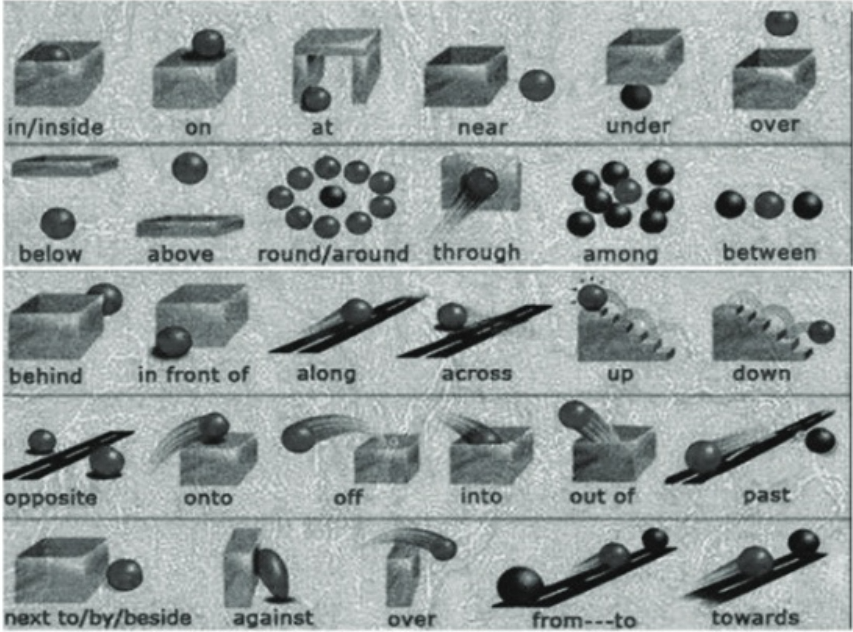
- This lesson is ______ prepositions.
- He goes _____ bed ._____ten o'clock.
- We reached there _____ lunch time.
- She sat _____ me.
- There is no difference _______ them.
- There is a school _______ our house.
- The cat sat _______ the table.
- I went ______ Dhaka ______ my father.
- We cannot live ______ water.
- The dog jumped ____ the wall.
D Look at the picture and describe the positions of things in it using prepositions. One is done for you:
In the picture, the file is on the table.
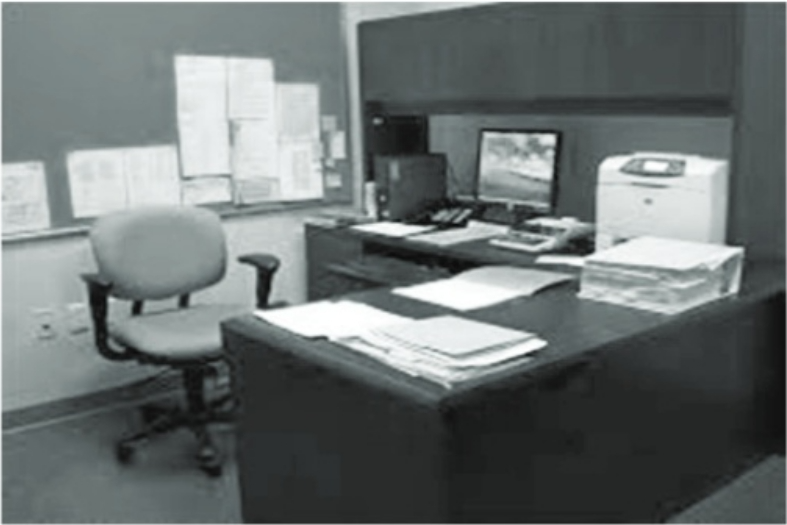
A Read the following passage and notice the words in bold.
Nazma and Diba are good friends. The former is tall but the latter is short. One day they were walking home from school. They were not in a hurry, yet they were walking very fast. Suddenly, Nazma's knee started hurting so she stopped walking. Diba also stopped and asked her what had happened. Nazma said that she could not walk because her left knee was hurting.
The words in bold in the passage have linked or joined together two or more words or ideas, phrases and clauses in a sentence.
These types of words are called conjunctions. They are often called linking words.
B Write few sentences on 'Your English Teacher' using as many conjunctions as possible.
C Read the following sentences and notice the words in bold letters:
Alas! He died at an early age.
Wow! What a nice gift!
Ugh! My teeth are aching.
Hurrah! We have won the match.
These are interjections. An interjection is a part of speech which expresses a strong feeling of joy, sorrow, surprise or disgust.
D Now use appropriate interjections to complete the following sentences:
- __________ ! What a beautiful garden!
- __________ ! He could not escape the accident.
- __________ ! I have a bad headache.
- _________ ! We have defeated them.
A Read the following passage and underline the verbs in it.
Azam is one of my close friends. He lives in Canada now. He often emails me. I received one email this morning. I will answer the mail soon.
What time does each verb refer to--present, past or future?
Note: Tense refers to the time of action or state indicated by a verb. According to time references, there are three main tenses:
- The Present Tense (refers to present state or different modes of present action)
- The Past Tense (refers to past state or different modes of past action)
- The Future Tense (refers to future state or different modes of future action).
Each of these tenses has four different aspects. They are: simple, continuous, perfect and perfect continuous. In this unit you will learn some of these aspects.
Read the following sentences and say which sentence refers to what time:
- It often rains here.
- It is raining now.
- It has been raining for two hours.
- It rained here yesterday.
- It was raining then.
- It had rained here before you arrived.
- It will rain tonight.
- It will be raining then.
- Rajib was sick yesterday.
- Suman is absent from class today for his illness. (Present state)
C Read the following passage and underline all the verbs in it. Say which verb refers to what time (present, past or future).
Mr. Hasan was once a poor man. But now he is quite rich. He works very hard.
He hopes that he will become richer in future.
A Read the following passage and notice the forms of verbs:
I am a student. Alam is my classmate. We two are good friends. We go to school together. We attend classes regularly. We often play together after school. We return home together. Alam lives in a house close to ours.
In this text the verbs 'am', 'is' and 'are' describe a present state, while go, attend, play, return, and lives indicate present actions. The sentences are all in the present simple tense.
B Read the following sentences and underline the verbs. Also notice their structures:
- English is an international language.
- These mangoes are very sweet.
- This book is not very big.
- Are you a student?
- Is the class small or big?
- Why are you late?
- Where is your father?
- Are they not your friends?
These sentences have 'be' verbs in present form and they indicate present states.
Verb Form: Base form of the verbs is used in case of the action verbs, and in case of the state verbs, present form of be verb 'am', 'is', and 'are' are used..
C. Read the following sentences and notice the verbs and their forms:
Jamil of class VI plays cricket for our school team.
The workers in the garments factories work very hard.
He lives very close to the school.
The earth moves round the sun.
These sentences contain action verbs. The verbs in the first three sentences indicate present action and the verb in the fourth sentence indicates universal truth.
D. Read the following sentences and see how interrogatives and negatives are formed in this tense.
I do not need your help.
He does not like music.
Do you read novels?
Does he come here regularly?
Where does he live?
When do you go to bed?
What auxiliary verbs are used to frame interrogatives?
How are negatives formed in the examples?
Verb form: be form
Note: In the present simple tense 'do' is used as an auxiliary verb before the subject in case of first and second person and also in case of plural numbers
of 3rd person subjects, and auxiliary 'does' is used in case of third person singular number subjects for framing interrogative sentences.
To make negative sentences 'do not' is used after first and second person (both singular and plural) and also after third person plural number subjects and 'does not' is used after third person singular number subjects for framing negative sentences.
When 'does' is used as an auxiliary verb after a third person singular subject, the main verb loses its 's/es'.
E. Write five sentences about 'Your Family using 'be' verbs and five more sentences using action verbs in the present simple tense.
a _____ b ______ C ______ d ______ e ______
F. Complete the following dialogue using negative and interrogative sentences:
Ruma: Do you watch television every day?
Suma: _________
Ruma: Neither do I. ________?
Suma: I spend my spare time reading books.
Ruma: _________
Suma: I often read adventure stories.
G. We can use 'have/has' as a main verb in the present simple tense. Look at the following examples.
They have a lot of money.
He has a nice car.
They have a big house.
How many children do you have?
Does she have a pet cat?
Now, write some other sentences like these using have/has as a main verb.
A Read the following passage and notice the verbs in the sentences:
I am going to Dhaka by bus. It is raining very hard. So the bus is not running very fast. Some passengers are sleeping. Some are gossiping. Some young boys are singing. A baby is crying and her mother is trying to appease her. What am I doing? I am watching all these things.
Notice that all the sentences in the passage express an incomplete action which is still going on.
Also notice the structure of the verbs in these sentences? Each sentence has an auxiliary verb (am/is/are) after the subject and then there is the main verb in the present participle form (verb+ing).
Verb Form: 'am/is/are +main verb+ing'.
B. Read the following conversation and say what time the verbs in it refer to.
Mim: What are you doing this evening?
Shanta: I am going shopping.
Mim: Are you playing badminton tomorrow?
Shanta: Yes, I am. Mukta is coming today to join us.
Mim: What time is she arriving? I am going to receive her at the station.
In these sentences it is seen that the present continuous tense is also used to indicate a definite future action.
C. Look at the following pictures and say who is doing what in it:
D. Read the following dialogue and say which sentences refer to present actions and which ones refer to future actions:
Sharmin : What are you doing there?
Sharif : I am getting ready to go to market.
Sharmin : What are you going to buy?
Sharif : My son is home tomorrow. So I am going to buy some sweets.
E. Write sentences of your own using the following verbs in the present continuous tense:
Walk, work, eat, drink, drive and wait
Now change your sentences into negatives and interrogatives.
A. Read the following conversation and notice the time reference of the action verbs and the verb structures in the sentences:
Teacher : Have you done your homework?
Student : Yes sir, I have done it.
Teacher : How many paragraphs have you written?
Student : I have written three paragraphs.
Teacher : Have you brought your work?
Student : Yes, I have.
Notice that each verb in the dialogue mentions a completed action; the action is over but there is still some effect of the action now. These are examples of present perfect tense.
Verb Form: The verb 'have/has' is used as an auxiliary verb after the subject and then the past participle form of the main verb is given. The verb form, then, is: have/has+ past participle form of the verb
These sentences are examples of the present perfect tense.
B. Now read the following negative and interrogative sentences in the present perfect tense and look at their structures:
I have not done my homework.
He has not come to class.
He has never told a lie.
Have you eaten lunch?
Where has he gone?
In the negative sentences, the negative word (not/never) comes after the auxiliary verb and in interrogatives the auxiliary verb comes before the subject.
C. Make correct sentences in the present perfect tence using given words:
- We/start/our journey
- Reba/wash/her clothes
- They/buy/a new car
- She/learn/the lesson
- He/not/come back/from school
- You/take/a bath?
D. Write five sentences in the present perfect tense describing what you have done in the afternoon today.
A. Read the following telephonic conversation between two friends and notice the sentences in bold.
Azad: Hello, Azad speaking.
Asif : This is Asif here. What are you doing?
Azad: Watching television.
Asif : How long have you been watching it?
Azad : I have been watching it for about an hour.
Asif : Can you see me within an hour?
Azad: It is raining hard.
Asif : Since when has it been raining?
Azad : It has been raining since 7 o'clock.
Asif : Then come when the rain stops.
Azad: Ok, bye.
The sentences in bold refer to an incomplete action which started in the past but is still going on. They are examples of the present perfect continuous tense.
Look at the sentences again and see the verb forms in each sentence.
B. Now complete the following dialogue.
Reza: How long have you been waiting here?
Anwar: _________?
Reza: __________ ?
Anwar: I have been looking for you since morning.
Verb Form: In the present perfect continuous tense you need to use 'have/has+been' as auxiliary verbs after the subject and then the present participle form of the main verb (verb + ing)
So, the verb form is: have been/has been +main verb+ing
In the sentences above see how 'since' and 'for'are used
N.B. Remember that 'For' indicates the total duration of the action and 'since' indicates the starting time of the action.
C. Ask questions using the following verbs in the present perfect continuous tense and then answer them in the same tense.
walk, read, drive, dance and speak
D. Write five more sentences using the present perfect continuous tense. Include negative and interrogative sentences.
a _______ b ______ c ________ d _______ e _________
A. Read the following text and notice the underlined verbs:
I was a student then. I had quite a few good friends. They were all very close to me. We did a lot of things together. We went to school regularly. We discussed our problems between classes. We played together in the afternoon. It was a happy time.
Think:
What verb form is used in the sentences?
How are questions framed?
How are the negative sentences framed?
In the text, 'was' and 'were' are used to refer to a past state, 'had' indicates a past possession/relation and 'did', 'went', 'discussed', and 'played' describe past actions. The sentences are all in the past simple tense. This is how states and actions are expressed in the past simple tense.
Verb Form: Past form of the verb is used after subject. No auxiliary verb is required except in interrogative and negative sentences.
Now write five sentences using 'be' verbs in the past simple tense.
Also write five sentences about the things you did yesterday.
B. Read the following dialogue:
A : Were you ill yesterday?
B: No, I wasn't.
A: Then why didn't you come to school?
B: We had a family picnic.
A: Where did you go for the picnic?
B: We went to the City Park.
There are negative and interrogative sentences in the past simple tense in this dialogue. Find them and see how they are written.
Note:
- Interrogatives are framed by using 'did' as auxiliary verb before the subject.
- Negatives are formed by using 'did not' between the subject and the verb.
- Remember that when did is used in the interrogative and negative sentences in this tense, the main verb becomes the present or base form of the verb, not the past form.
- Wasn't is the short form of 'was not' and didn't is the short form of 'did not'.
Now read the following sentences and see how past states are expressed in the past simple tense :
I was sick last week.
He was my best friend then.
We were very happy.
They were unhappy.
Here we notice that 'was/were', the past form of 'be' is used to refer to past state. In these sentences 'was/were' is used as main verb. It is followed by a noun or adjective.
Now read the following negative and interrogative sentences and notice the positions of 'not' and 'was/were':
The food was not good.
They were not present there.
Were you absent from the class?
Why was he angry?
Were they not poor then?
Say how interrogatives and negatives have been formed in these sentences?
C. Write sentences in the past simple tense with the following verbs:
phoned, met, invited, bought, attended and happened
D. Read the following sentences, notice the use of 'had' and answer the question below the sentences.
We had a nice garden.
We never had a car.
They did not have much money.
How many pens did you have?
See how 'had' is used in these sentences-- as an auxiliary verb or a main verb?
Note: 'had' is used as a main verb to mean possession in the past simple tense.
E Complete the following sentences in the past simple tense. Use the right form of verbs given in brackets:
- It _____ all day yesterday. (rain)
- Did you ______ the party? (enjoy)
- His father _______ ten years ago. (die)
- Why ______ you angry? (be)
- I did not ______ any such idea. (have)
- He ______ me how to swim. (teach)
- How long did you ______ there? (stay)
- My mother _____ a teacher. (be)
- How ______ the weather yesterday? (be)
- Last week I _______ cold. (catch)
F Write five to seven sentences describing what happened in your English class yesterday
A. Read the passage below and notice the time reference of the action verbs in the sentences in bold:
It was 5 o'clock in the evening. It was raining lightly. I was sitting at a tea-stall by the side of the road. I was taking tea and watching the people on the road. The people were walking hurriedly for shelter. An old woman was crossing the road. A bus was running at a high speed. Suddenly the bus ran over the old woman.
Say:
What is the verb form of the sentences in bold?
Is the action complete or over or it was still going on at a point of time in the past?
Note: Notice that the bold sentences in this passage refer to some actions which were going on at a certain time in the past.
Form: 'was/were' is used as auxiliary verb and base/present form of the main verb+ ing is used. So the verb form is: was/were+verb+ing.
Write five sentences in the past continuous tense on 'what were you doing at about 10:00 pm last night' using the following verbs:
write, play, sleep, laugh and drink.
B. Read the following dialogue:
A: What were you doing in the evening yesterday?
B: I wasn't doing anything in particular.
A: Were you studying?
B: Not at all.
A: I was calling you but you were not responding.
B: Then I was possibly talking with my father.
There are some interrogative and negative sentences in the dialogue. See how the interrogative and negative sentences are framed in this tense.
Note: In framing negative sentences in this tense 'not' is used after the auxiliary verb and in the interrogative sentences the auxiliary verb 'was'/'were' comes before the subject.
C Complete the following sentences using the past continuous tense. Use the appropriate auxiliary verb in the first gap and the right form of the main verb (given in the brackets) in the second gap:
- At 8 o'clock mother ______ ______ dinner. (cook)
- I _____ then _____ a bath. (take)
- Zinnia ______ ______ ready to go out. (get)
- You ____ ______ a phone call. (make)
- What ____ they ____ then? (do)
D. Write a few sentences describing what you were doing this time last week. (Note Past perfect and Past Perfect Continuous tenses will be dealt with in the grammar book of class VII)
A Read the following conversation and notice the time reference of the verbs and the verb forms in the underlined sentences:
Raghib: I have no money in my pocket. What shall I do now?
Zeenat: Don't worry. I shall lend you some.
Raghib: Will you please give it right now?
Zeenat: Here you are.
Raghib: Thank you. I will repay you the loan tomorrow.
Zeenat: That will be fine.
The underlined sentences refer to a future action. The modals 'shall' and 'will' are used to indicate simple futurity. You have seen that the modal is followed by the base form of the main verb. These are examples of the future simple tense.
B. Complete the following dialogue using the future simple tense:
A: Will you sleep now?
B: __________
A: When will you sleep then?
B: ________
A: _______
B: I will write an email.
C Write a few sentences on 'what you will do on new year's eve' using the following verbs in the future simple tense:
phone, call, stay, sleep, eat and drink
Now change each of your sentences into negatives and interrogatives.
In negatives, 'not' will come after the modal and in interrogatives.
the modal will come before the subject.
D Write a few sentences in the future simple tense describing 'your plan for the coming winter vacation'.
A. Read the text and notice the words in bold.
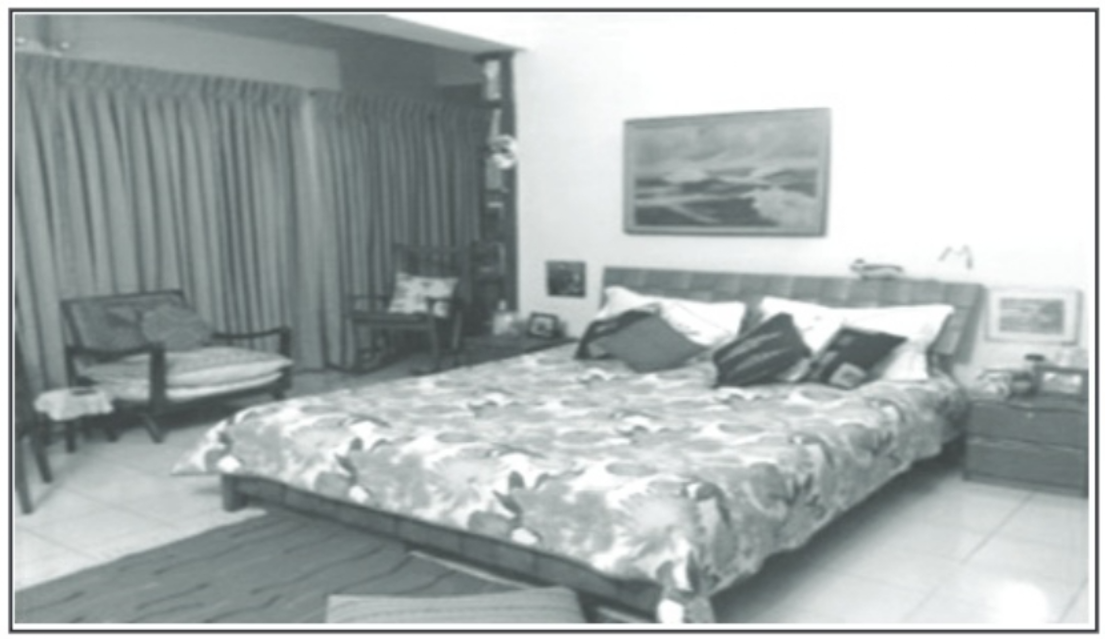
This is Asma Ahmed's bed room. The room is very neatly made. It has a bed with pillows, cushions, and a colorful, flowery bed-cover. There's a rug in front of the bed with another big cushion. An excellent painting of the sea is hanging from the wall while another small painting is kept on the top of the right side-table. The room has a rocking chair and a sofa at the left corner. The windows are covered with large heavy curtain. Can you see a mask somewhere around the bed?
The bold words in the passage are examples of articles in English. Can you find out any principle or rule about the use of a, an, and the in the passage .
Use of articles
- We use a/an to talk about something for the first time.
e.g. a bed, a bed-cover, a rug, a rocking chair, a sofa, a mask In the text above when the speaker uses any singular countable noun, s/he uses either a or an before it. - We also use a/an to refer to something unspecified, e.g. not particular or specific.
She bought some apples from a shop in the new market. In this sentence the shop in the new market is not specific as there are many shops in the new market. So, article has been used before it. - a is used before consonants and 'an' is used before vowel
- a is used before vowel 'U' when it is pronounced as 'you'. So, a university, not an university.
- an is used before consonant if the first 'h' of a word is silent: an hour, an honest man etc...
- We use the when we refer to something for the second time .g. This is Asma Ahmed's bed room. The room is very neatly made. (room:1st time) (room: 2nd time)
- We use the when we refer to any person or object specifically. e.g. There are few windows in the room. The windows are covered with large heavy curtain.
In the second sentence, the windows are specific in the sentence: which windows the speaker is referring to? The windows are the windows of Asma Ahmed. - We also use the to refer to something that has no alternative. e.g. The sun is the source of energy in the earth.
B. Fill in the blanks in the following conversation with a, an, or the, if necessary
: Do you like banana?
: Hmmm...not exactly.
: Would you like to have _____ (a) banana now?
: Since you don't have anything else and I'm hungry, so yes, please.
: Which ______ banana would you like to have? I have local
banana and the imported banana.
: _______ : Ok, here you are. Now I'll have the imported one. That is bigger.(The) local banana, please.
C. Here are a few things that people generally like or dislike. Think about them and make your own statements. An example is given for you.
I usually don't like apples because they aren't fresh but yasterday the apple I ate was so fantastic.
melon | banana | wood apple | eggs | milk | black tea/coffee |
fish | mixed vegetable | potato | pastry | chocolate | pineapples |
i) __________
ii)__________
iii)__________
iv)__________
v)___________
vi)__________
D. Fill in the blank spaces with a, an, the, or a cross (x) mark.
i) ______ motor vehicles and _______ greenhouses cause pollution and it damages ______ environment.
ii). All pollutions are bad but _______ pollution we cause in _______ water is perhaps the worst.
iii) I love watching _______ movies. movies are good sources of entertainment. Last week I saw a movie - Troy. It was fantastic.
iv. ________ Honesty and ________ sincerity are two great qualities of human life.
v) However, sometimes it appears that ________ honesty and ________ sincerity our farmers are showing everyday are not evaluated.
vi) I am a food taster. I like even ________ food of small ethnic groups. Last time _______ foods I tried in Rangamati and Khagrachari were great.
vii) _____ world is yet to ensure _____ food for all.
viii) My brother is studying ______ history. His special interest are _______ history of the Faraoh and ______ history of _________Post-Communist Era.
Now write two sentences using a/an in one sentence and using the in the other.
F. Two friends are talking to each other. Read their conversation and fill in the gaps with a, an, the, or a X.
Sara: If you have _______ flu, do you go to ______ bed or you continue your ______ study as well?
Merry: Horrible flu! Sorry, I usually go to ______ But this time I had to study as _____ exam was very near.
Sara: we meet each other after a long time. Let's celebrate. Would you like to eat ________ lunch at a nearby restaurant, or go to ______ posh one?
Merry: Let's go to _______ one we explored last time. It should be near here.
Sara: How do you like to learn ______ English? Do you go to _______ specialist teacher or you prefer ______ coaching centres?
Merry: _____ teachers in my school are fluent as well as helpful. I also watch ______ English channels.
Sara: How do you go to your school? By _____ CNG, _______ rickshaw, or on ______ bus?
Merry: I just walk.
G. Read the following text. Follow the use of articles. If they are correct, put a tick mark (v) in the blank space. If wrong, correct them. The first one is done for you.
Waiter : Do you have a reservation?
Customer : Oh yes. My name is Jonathan Gomes.
Waiter : You have booked a table for six, right?
Customer : Yes. But can I have a larger table please, a table for eight?
Waiter : The table in the north is booked for you. And it can accommodate 8 persons.
Customer : That's great.
Waiter : Would you like a drink, first?
Customer : Yes, water please...And may I have a menu please.
Waiter : The menu is just beside the napkins.
Customer : Ok, please give us the fried rice, the mutton kabab, the vegetable with chicken, nuns and chicken sizzling.
Waiter : Would you like a dessert?.
Customer : A ice cream for each. By the way, manager is known to me. Can I speak to him?
Waiter : He is not here. You can speak to a floor supervisor.
After some time
Customer : Can I have a bill now?. ________
Waiter : Sure. I'll be back in an minute ______
H) Read the following text and fill in the blank spaces with appropriate articles.
My father is ________ (i) fisherman and we live in ________ (ii) coastal area. Every day my father goes to _______ (iii) sea with some other fishermen. Sometimes they go early in ______(iv) morning and come back at late night. Sometimes they do not return ________ (v) couple of days. ______ (vi) most joyful moment in our life is when we hear ______ (vii) voice of our father at______ (viii) end of _______ (ix) day. Often he comes back with some fresh fishes for us. We pass time in anxiety when ________ (x) Kalboishakhi comes. Any natural disaster is terrible. Every year some of our near and dear ones are washed away by ________ (xi) sea. They are ______ (xii) victims either of (xiii) cyclones or tidal surge, or Kalboishakhi. Our women are very brave and so are we. We say good bye to ________ (xiv) men every day and don't know when they will be back. Yet we wait. Sometimes we wait for _______ (xv) whole life but they never come back.
A. Read the following passage and notice the use of possessives.
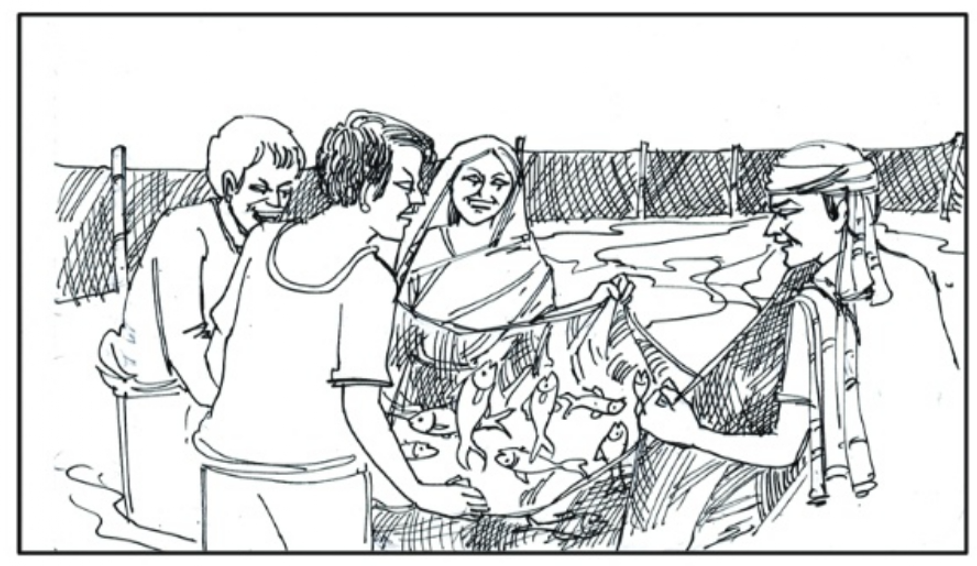
We have a small farm in our village. My father and his friend Mr. Mrinal own the farm. The name of the farm is Muradnagar Motsho Khamar. My father's name is Alimuzzaman. Our farm is a fish farm. Many of our neighbours are employed there. The customers are our village people, some nearby stores and also some big department stores in Dhaka city. All the members of our family work for our business. Mr. Mrinal's family is also spending much time for it. The condition of the business is really good. We are really proud of our business. Working for the growth of the business is the dream of mine. Our neighbours' families will be benefitted by that.
Look at the words in the text and see the different types of possessive in the following chart.
| Possessive adjectives | Possessive pronouns | Possessive with's or s' | Possessive with of |
| my our your his their | mine ours yours his/hers/its theirs | father's Mr. Mrinal's neighbours' | of the farm of the business |
Possessive adjectives
Possessive adjectives are words that go before nouns to talk about-
- belongings: I want to complete my homework first.
- relationship: Mahin says that his mother is a banker.
- parts of the body: Rimu has broken her leg.
- things that are connected with us: We have planted fifty coconut trees in our school.
In the above examples, 'my', 'his', 'her' and 'our' are possessive pronouns because they show possession.
Activity 1
Now read the following text and fill in the gaps with possessive adjective.
_____ father came to this city forty years ago. He was quite a young man then. _______ dream was to run a business here in this small town and live happily. _________ difficult now to understand how small this city was forty years ago. I can't imagine _______ beauty either _______ father brought all __________ family members in a rented house. They moved from ________ village home. Can you think about _________ hopes and anxieties during the initial days?
Possessive pronoun
- We use possessive pronoun to talk about something that belongs to us or is connected with us, It is usually used at the end of a sentence and is not followed by noun.
- We also use a possessive pronoun which thing we are referring to. We have already mentioned the thing in an earlier sentence.
Activity 2
Read the conversation between two friends. Complete their conversation by putting in the correct possessive adjectives and possessive pronouns as needed.
Bindu : How about _____ garden project?
Titul : Fantastic! I took _______ suggestions.
Now I'm spending more time behind it.
Now the garden is full of different flowers.
Everyone is amazed to see _______ beauty.
How about _____ )?
Bindu: _____ is like yours.
But this time I've planted some new cactus.
I'm inspired to see Laila's garden.
The speciality of ______ is- it is full of white flowers and they are mostly local flowers.
Titul : Did you go to _________ (use Antara) garden.
Bindu : Not yet. Let us go to see them one day.
After all they are _______ friend.
Activity 3
Mita and her brother Imran are going to meet their aunt's family at Satkhira. Complete the conversation by putting correct possessive adjectives, possessive pronouns.
Mita: Imran, have you packed _______ suitcase?
Imran: No, sister. Not yet. Have you done _____?
Mita: Yes, I have done ______ yesterday ?
Imran: What things have you taken?
Mita: I have taken some of _____ (1) clothes.
Imran: Okay. ______ shirts are at the laundry. Do you need to press some of ____ (you)
Mita: No. I have already done at home. Take ______ sweater. It will be pretty cold at Satkhira.
Imran: Okay. I will take a sweater and _____ (Arman) jacket.
Mita: Why? What happened to ______ ?
Imran: The sleeves of the jacket have become dirty.
Mita: Okay. Then you can take_______(he).
Imran: What is the scheduled time of the train?
Mita: It is at 6 am. We have to start _____ _ (we) journey from home before 5am.
Activity 4
Rewrite the following sentences. Use possessives as necessary. The first one is done for you.
a) What is the name of your best friend?
What is your best friend's name?
b) What is the colour of the shirt of your colleague?
___________________________________
c) What is the address of her partner?
___________________________________
d) What is the last name of your sister?
___________________________________
e) What is the height of his brother?
___________________________________
f) What is the favourite food of your mother?
___________________________________
Read the following conversations and notice the use and positions of -ing verbs.
1.a. Samim: What do you like to do at your free time?
1.b. Samiul: I enjoy watching movies with my friends.
(watching: object of the verb enjoy)
2.a. Ria: Would you mind closing the door? (closing: object of the verb mind)
2.b. Bivu: Not at all, I was also thinking of doing the same.
3.a. Promi: I like jogging in the morning. How about you?
3.b. Sujon: Jogging in the morning is good! But I hate it.
In fact, I don't jog.
Cycling in the afternoon is ok for me.
(Jogging is object of the verb like in 3.a.
Jogging is subject of the sentence in 3.b.
Cycling is the subject of the sentence in 3.b.)
4.a. Do you like pizza?
4.b. I hate eating greasy foods.
(eating: object of the verb hate)
5.a. Shuvro: What type of classroom activity is your favourite?
5.b. Pia: I love learning by doing.
6.a. Shuvro: How about lectures?
6.b. Pia: Attending lectures is boring.
(learning by doing: object of the verb love) (attending lectures subject of the sentence)
Sentence begins with -ing verb in in 3.b; and 6.b. Here verb+ing is used as subject of the sentences.
Sentence begins with -ing verb in 1.b; 2.a, 3.a, 4b, and 5b. Here verb+ing is used as object of the sentences.
Grammar point
When -ing verbs are used to begin or complete sentences (i.e. used as subjects or objects), they have nominal function (function of a noun) and they are called gerund. A gerund is also called a verbal- noun. It looks like a verb but functions like a noun.
We also use -ing form as the subject of a sentence when the subject is an action or situation, not a person or thing. In that case, we need a complement or object at the end.
Examples
Walking is a good exercise. (-ing verb as subject followed by a
ing-verb linking verb complement linking verb and complement)
Working too hard ruins his health. (-ing verb as subject followed by verb and object)
When -ing verbs are used after another verb, they are objects.
i) We use -ing verb after various verbs connected with liking or not liking something: like, love, enjoy. hate
ii) We use -ing verb after mind in negative statements to say that we are not angry or unhappy about something:
I would like to buy a new car. I don't have sufficient money.
I don't mind lending you some money.
Thanks. Not now.
iii) We use Would you mind followed by -ing verb to ask someone to do something politely.
Would you mind closing the door, please? It's very cold, isn't it?
Not at all. I was also thinking the same.
Make sentences by matching words from columns A and B. Each phrase can only be used once. The first one is done for you.
| Column A | Column B |
| a. Browsing net is | i. playing drums. |
| b. He admitted | ii. seeing him. |
| c. But he denied | iii. watching it. |
| d. I also didn't see him yesterday. At least I don't remember | iv. entering my room in my absence. |
| e. James doesn't like sport and he hates | v. James' passion. |
| f. He still likes singing but he has stopped | vi. using my computer. |
a. Browsing net is James' passion.
b. _____________________
C._____________________
d._____________________
e. _____________________
f. _____________________
Activity 2
Lima and her friends do a lot of activities. Look at the pictures and complete the sentences using gerund. Use the verbs like, love, enjoy, hateas needed. The first one is done for you.
| Picture 1: some girls are chatting together. | Picture 2: bicycle | Picture 3: swimming | Picture 4: singing | Picture 5: playing football | Picture 6: shopping |
a. Linda Likes chatting with friends. Chatting together is Linda's favourire pastime.
b. _____________________________________________________
C. _____________________________________________________
d._____________________________________________________
e. _____________________________________________________
f _____________________________________________________
Activity 3
Zami is 12 years old. Recently his has shifted to a new town to live. Here he talks about his experiences. Complete what he says, using -ing form of the correct verbs from the box. The first one is done for you.
| i | ii | iii | iv | v | vi | vii | viii | ix | x |
| cross | go | shop | leave | find | meet | cross | understand | travel | see |
zami's family came to live in this small town about a year ago. At first, it wasn't easy. (a) Findinga suitable place to live was difficult. (b)_ ______ people was another problem, because they speak with local dialect here. But things are better now. They are living in a small house in the town. Zami likes (c) ________ and (d) _________ is easy here! Everything is available around. (e) ________ is a bit difficult as there are a few trains to go to other places. (f) _______ the roads is not difficult like big cities.(g) _______ out is great fun because there are many places to go around. Jeremy loves (h) _________ new places and (i) ______ new people. Jeremy is happy with this life. Zami hated (j) ________ their previous town but they are okay now.
Read the following conversations and notice the positions of -ing verbs.
Pikul : Do you like birds, Raja?
Raja : Oh sure! I love them.
Pikul : What bird is your favourite?
Raja : Parrot. I've a singing parrot! (singing modifies parrot)
Mitu : Hi, ever smiling boy! Why are you sad today?
Shanto : I've lost my new English book.
Mitu : How did you lose it?
Shanto : I went over there. Some students were laughing at a crying girl. She was holding a melting ice-cream bar in her hand. When I came back, the book was gone!
Grammar Focus
As indicated above, a participle can be made by adding ing to a verb. However, it becomes a participle only when adding ing to the verb makes it function as an adjective. A participle is also called a verbal adjective as it looks like a verb but functions like an adjective; it modifies a noun or pronoun.
singing parrot smiling boy crying girl a melting ice-cream bar
What type of parrot ? a singing parrot. singing works as an adjective
What type of boy? a smiling boy smiling works as an adjective
What type of girl? a crying girl? crying works as an adjective
What type of ice cream? a melting ice-cream bar melting works as an adjective
Activity 1
Read the following text and fill in the gaps using participle. Pick the suitable words from the box below. The first one is done for you.
| run | love | fly | shine | look |
Raja has a singing parrot. It's a nice bird. His uncle brought this bird from his village. Now the bird lives in a ________ cage. Everyday Raja feeds the bird and looks after him. Raja feels very good when the bird sings. Sometimes Raja takes the bird under ________ water to bathe him. Raja loves the bird but he doesn't like seeing birds in the cage. Raja likes free ________ birds. But due to his ________ uncle he can't do anything. Raja has decided to discuss the matter with his uncle.
Activity 2
Read the following text and fill in the gaps using participles of the verbs in the box below.
| roar | chirp | smile | sleep |
| walk | jump | cook | fry |
Tuli went to her (a) ______ mom. Mom is cooking a special dish for them. Tuli felt tempted seeing the (b) ______ fish. She wanted to have one piece. Her (c) ________ mom told her to wait a bit. Tuli told her mom about her zoo visit experience the last day. She saw some (d) _________ elephants, (e) _______ tigers, (f) _______ lions, (g) _____ jumping monkeys, (h) ______ birds and many other things there. Tuli requested her mom to take her there again.
Grammar Point
Gerund vs Participle
Gerund
People are confused about the use of gerund and participle because of their similarities in form. Both are formed by adding ing to a verb. There is another similarity, and that is the fact that both gerund and particle indicate some action or state of being. However, there are differences between them which is highlighted here.
Participle
As seen above, present participles are formed by adding ing to a verb. However, it becomes a participle only when adding ing to the verb makes it function as an adjective. It is also called a verbal noun.
| What is the difference between Gerund and Participle? A gerund is a verbal noun (verb made noun by adding ing) that looks like a verb but functions as a noun. It is called a verbal noun. • A (present) participle is also formed by adding 'ing' to base form of an action verb, but it functions like an adjective. It is a a verbal adjective. They are structurally the same, but functionally different. A gerund functions as a noun, but a participle functions as an adjective. |
Read the following examples.
Liza has lost her pen. She is looking for it. She says:
I have lost my ball point pen.
I cannot find it anywhere. Have you seen my pen?
Oh, how absentminded I am!
I kept it in my drawer.
If anyone gets it, please give it back
Each of these examples has a number of words arranged in a proper order and the words are arranged in a sequence that makes a complete sense.
Activity 1
Now read the following text and fill in the gaps to define what a sentence is. A sentence is a group of ______ with at least a _______ and a _______ A sentence has a complete ________.
Types of sentences
Now read the following dialogue between a son and a mother.
Son : Hi Mom!
Mom: Hi dear!
Son : Mom, I have to go to Minhaz's house now.
Mom: No, it is almost dusk. You cannot go out now.
Son: Please, mom. His father is sick. We have to take him to a hospital.
Mom: Oh, I see. Did Minhaz ring you?
Son: Yes, Mom.
Mom: Okay. Go then, but don't be late.
Son : So nice of you, mom!
Mom: Go. Hurry up and take care.
Son : Bye, Mom.
Mom: Bye, dear.
Read the following chart which shows some of the sentence types with one example of each type.
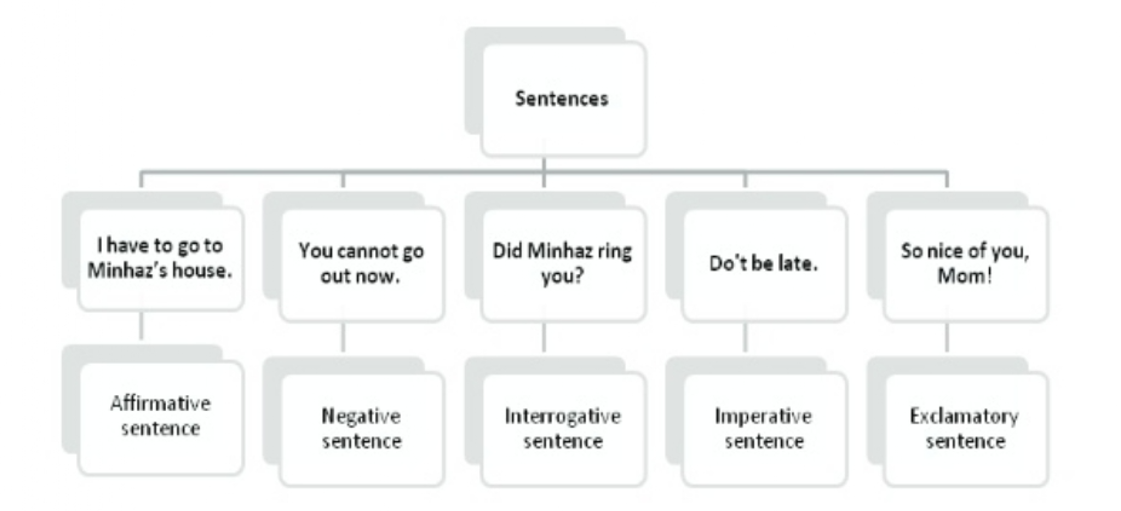
Activity 2
Follow the examples of sentence types and write a couple of sentences for each type.
Affirmative : ________________________________________________
: ________________________________________________
Negative : _________________________________________________
: _________________________________________________
Interrogative : ______________________________________________
: _________________________________________________
Imperative : _______________________________________________
: _________________________________________________
Exclamatory: ______________________________________________
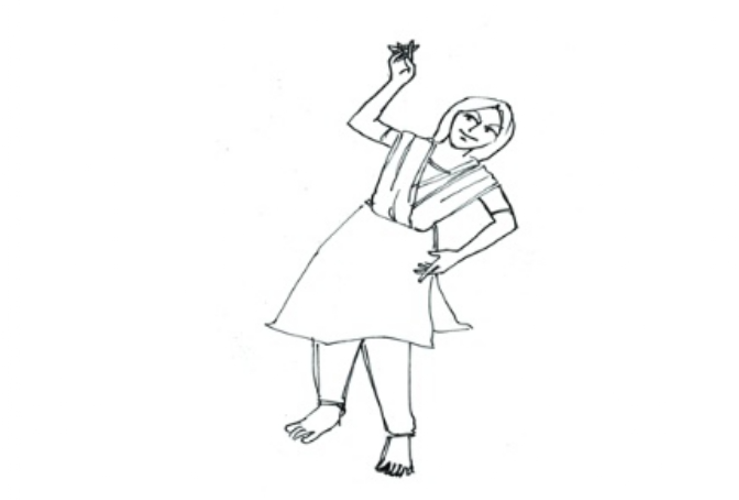
Tonusree is Alfaz's classmate. She is a good dancer. She also sings well. This year she is going to take part in Khulna district level dance competition. She wants to be the champion there.
The above sentences are positive statements. These types of sentences tell about a person or a thing. These are called affirmative sentences. An affirmative sentence needs
A subject + linking verb + complement
Tonusree is Alfaz's classmate
She is a good dancer.
Subject + intransitive verb
She also sings well
Subject + transitive verb + object
She wants to be the champion there.
Activity 3
Read the text below and underline the subject and verbs. Make a list of the verb types used here.
Boby's best friend is Talha. Talha is not the first boy in the class. Yet Boby likes him. Talha's language is very good. He speaks in perfect Bangla. He draws good cartoons. He is also a genius in computer games. Talha is a cricket player too. He likes fielding. Everyday Talha and Boby share tiffin. They like to sit together but often their teachers ask them to sit apart. Only the science teacher allows them to sit together. They both like her a lot.
Now write five affirmative sentences about your parents.
Read the text below and notice the sentences in bold:
Alfaz is a student of Tarar Mela School. He lives in a small town and doesn't like big cities. He thinks that big cities do not allow people to grow properly. Alfaz likes open fields, rivers, and nature. He is not allured by the big buildings and colourful lights of the cities. He likes the fresh foods and the known faces in his town. I have been Alfaz's friend from my childhood. We have many things in common. I also do not like city life that much. We have another interesting similarity. We are not cricket fans. We like football.
The text above has examples of negative sentences written in bold words.
Negative sentences are used to express
- dislikes : He lives in a small town and doesn't like big cities.
- disapproval : Big cities do not allow people to grow properly.
- disagreement
: Alam is a very naughty boy.
: Sorry, he is not a naughty boy. I found him very
:sober and gentle. - : Are you okay now?
: Not exactly. I can't walk any more.
How to make negative sentences?
Subject + auxiliary or supporting verb+ not + action verb +.... (He doesn't like big cities.)
Subject + be verb+ not + ____ (He is not a naughty boy.)
Subject + modal +not + ____ (I can't walk anymore.)
Activity 1
Write 2 sentences describing your own dislikes.
1. _________________________________
2._________________________________
Now write another two sentences describing your father/mother's disliking.
1. _______________________________
2._______________________________
Activity 2
Read the text below and fill in the gaps in it with an appropriate word from the box.
| didn't | won't | doesn't | am not |
| hasn't | couldn't | is still not | didn't |
Akash is my best friend. He ________ come to school for last few days. I came to know that he is sick. I _______ go to see him as my house is far away from his. I phoned his brother but he _______ respond. Maybe he was busy. Akash ______ okay. My friend Taposh lives near Akash's house. I will give Taposh some story books for Akash. I _______ feeling good in absence of my best friend. If he _______ come round soon, I go to the school picnic. I need to tell Akash that we have a new teacher in our school. I'm sure Akash _______ see her before.
Note: Both affirmative sentences and negative sentences fit to the category of assertive sentence. An assertive sentence makes a statement about some person, thing or event. It may be both positive and negative statement.
Read the conversation between the son and the mom after he returns from hospital and look at the queries she makes.
Mom: Hi dear. How is Mr. Abed now?
Son Oh, he is much better.
Mom: What happened to him?
Son: He was feeling restless. He had suffocation as well.
Son: When did the doctor see him?
Son: Immediately after he was taken to the hospital. A couple of hours ago.
Mom Is he still at the hospital?
Son Yes, he is and will be there for next 24 hours.
Mom: Does he have any pain in the chest?
Mom: Yes, a little.
The bold sentences are asking for some information. These are called interrogative sentences. A note of interrogation (?) is used at the end of an interrogative sentence. These sentences have the following attributes:
a) The be verb (in case of state verbs) or auxiliary verb (in case of action verbs) comes before the subject.
e.g. Is he still at the hospital? (Be verb before the subject)
Does he have any pain in the chest? (Auxiliary verb before the subject)
b) The sentence starts with either the auxiliary verb or 'wh' words (who, which what, when, whom, how, whose, why)
e.g. When did the doctor see him?
Note: when a question begins with a be verb or an auxiliary verb, that is a yes/no question. When a question begins with a wh-word, that is an information question or wh-question.
Activity 1
Read the following interview. Make questions for each statement.
1. ____________________?
2. I'm Monica. Monica Gonzalej.
3. __________________
4. I'm from Meherpur.
5.__________________ ?
6. Oh, I'm from Amjhupi.
7. _________________ ?
8. Only a week ago.
9. _________________ ?
10. My family has moved to this city due to my father's transfer.
11. __________________?
12. Yap, many times. I have some relatives here.
13. __________________ ?
14. No, you are my first friend.
Activity 2
Suppose you are going to interview one of your friends regarding his family members. Make five wh-questions and another 5 yes/no question for him/her.
1. ____________________________________
2.____________________________________
3.____________________________________
4.___________________________________
5.___________________________________
6.___________________________________
7.___________________________________
8.___________________________________
9.__________________________________
10.__________________________________
Read the text and answer the questions below it:
Dear students, silence please. Look at me. Try to guess what I want to tell you by my body language. Please keep silent. Now go straight and left. Cross two blocks. Turn right. Find out the red building. Speak to the security people there. Tell them that you are from Modhupur High School. Show them this paper if they ask you to prove your identity. Don't enter inside until they ask you to do that and don't lose this paper, please.

a. How does each sentence begin?
b. What is the purpose of these sentences?
In the above sentences, someone asks the listener to do something. These are imperative sentences. The imperative sentences begin with a verb in the base form. To make negative sentences using imperative you need to begin the sentence with don't and then use the verb. If the sentence is for request, use please at the beginning or in the end with a comma (,).
Imperatives sentences are used to give commands, instructions, advice, or make requests.
Activity 1
Here is a recipe for making orsaline. Each sentence needs a verb at the beginning. Choose them from the verbs given in the box and write them in the blank spaces.
| stir | pour | add | take | don't add |
_________ a clean jug.
_________ two glasses of boiled water with normal temperature in it.
_________ a handful of sugar and a pinch of salt.
_________ with a clean spoon.
_________ anything else.
Activity 2
Give the recipe for (a) boiled egg and (b) making an omelet. Add at least one negative sentence in imperative.
| Boiled egg | Omelet |
| 1. | 1. |
| 2. | 2. |
| 3. | 3. |
| 4 | 4 |
| 5. | 5. |
| 6. | 6. |
| 7. | 7. |
Activity 3
Suppose you meet a new person in front of your home. The person would like to go to your school but she doesn't know how to go. Give proper directions. Tell her at least two things not to do.
Read the following sentences.
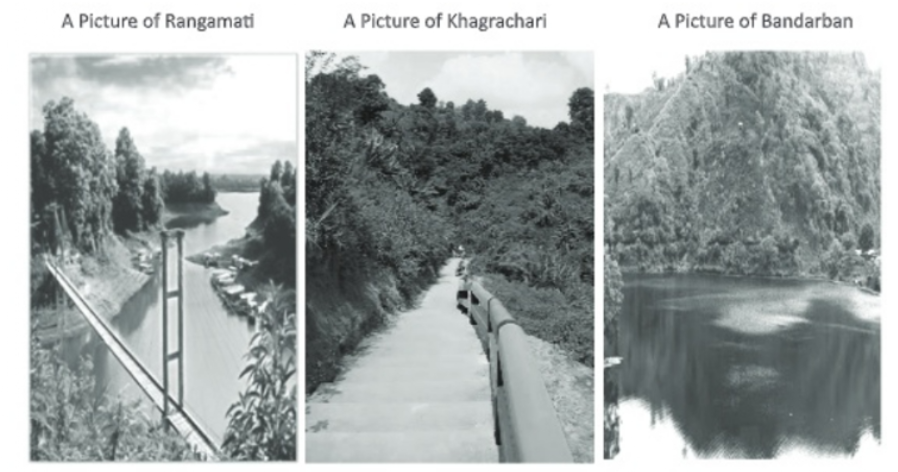
Steve Ansell is a tourist. He is visiting Bangladesh and now travelling Rangamati, Khagrachari, and Bandarbans. Yesterday he went to Nilachal and Chimbuk Pahar (hill). On the way he was surprised to see the floating clouds on the top of the hills and trees around. Many times he uttered, "Wow! What a great surprise! What a fantastic view!" Steve has taken many snapshots of the natural beauties of Bangladesh. Many times he showed me the photographs taken from Rangamati Lake and told me, "How wonderful your country is!" He added Bangladesh is truly called 'The beautiful Bangladesh'. Steve will explore Khagrachari tomorrow.
The underlined sentences in the text above are examples of exclamatory sentences. All sentences express Steve's excitement to see the natural beauty of Bangladesh. That is exactly what exclamatory sentences are used for. These sentences usually start with 'how' or 'what'. A note of exclamation (!) is used at the end of these sentences.
If you begin your sentence with 'how, then an adjective follows the word.
Eg. "How wonderful your country is!" (How + adjective+subject+verb)
If you begin your sentence with 'what', then a noun follows.
e.g. What a great surprise! (what+ noun+subject+verb) (meaning What a great surprise it is!)
b Sometimes we use some short exclamatory words at the beginning of these sentences.
Examples
Hurray! Our school football team has won the match.
Damn! They have scored another goal!
Alas! His father is no more.
Oh dear! Very sorry to hear your distress. I'm sure you will be okay soon.
Gosh! These kids will make me mad.
Activity 1
Here are some situations. Read them and write how you are going to express your surprise or excitement in these situations.
Your favourite cricketer has scored a century.
______________________________
You are surprised to see the beauty of St. Martins Island.
______________________________
You hear any interesting news.
______________________________
You read a book and is impressed by a character.
______________________________
Your friend has broken his leg in an accident.
______________________________
You are sympathetic to the misery of a friend.
______________________________
Your brother saved a baby from an accident by risking own life.
_______________________________
Read the following text and notice the use of introductory 'there' and 'It'.
I am a student of class six. I go to Magura Govt. High School. It's an old school and quite famous. There's a big open field in front of our school. There's a large pond at the back of the school too. There're one thousand students and 50 teachers in our school. We are proud of our school. It's 11 o'clock now. It's time for our 1 period. It's a clear sunny day after two rainy day's. I feel wonderful today.
We've our school uniform. It's a white shirt with white trousers. Teachers do not allow students to enter classes without uniform. It's good that teachers are strict on this point. A few days ago, there was an accident on our way to school. One of our students was knocked down by a rickshaw. Nobody knew the name of the boy. But the boy had school uniform. So, it was not hard for people to contact the school.
How do the underlined sentences begin?
Use
- We use there to say that something exists.
e.g. There is a big open field in front of our school. - We can use there to talk about things that happen, and situations.
e.g. There was an accident on our way to school. - We can use there for a number of people and things.
e.g. There are one thousand students and 50 teachers in our school. - We use it to give time, day, month, date, etc.
e.g. It's 11 o'clock now. - We use it to describe someone's situation.
e.g. So it was not hard for people to contact the school. - We use it to talk about weather.
e.g. It's a clear sunny day.
Activity 1
Angshu is visiting Kuakata. He writes a mail to one of his best friends Adrita. In the mail both introductory 'there' and 'it' have been used. Read the mail and circle the correct words.
Dear Adrita
Greetings from Kuakata. There's/It's really good to be here and I'm enjoying myself. There's/It's a good time of year to come to this place because there's/it's not tourists crowded now. They say, there are/It's a lot many places to explore here. But there's/it's not possible on my part to see everything. You know, I'm here only for a few days. There's/It's 2 o'clock in the afternoon now. I'm sitting before the sea under a huge colorful umbrella. There's/It's breezing now. No words can describe my feeling. There are/It's some pine trees at my back. I can hear some birds chirping from there. I can hear the roaring of the sea. There are/It' some boats fishing in the sea. Everything is very calm and quiet. There's/It's lunch time now. So I'm planning to go to a local restaurant. The fish curry is wonderful in these restaurants as everything is so fresh. There's/It's a fantastic place, Adrita. Do visit here next time.
Activity 2
Moni and Tina are discussing what to do. Complete their conversation by putting there or it in the gaps.
Moni: You see Tina, the exams are over. 's boring that we are passing time doing nothing. Why don't we do something exciting?
Tina: You are quite right. Well, Rashed, at the cinema. war. We can go and see that. 's a new film, Amar Bondhu 's a child-movie on our liberation
Moni:Mmm. 'a good idea. I like watching movies in the large screens of the cinema halls. But is it truly a good film?
Tina : Well, a good review of it in the daily Voice. I read it. Besides, my uncle with my nephew and niece went to see the movie and they liked it very much.
Moni: Ok, then let's go to watch this movie today. Tomorrow we will plan something else.
Activity 3
Here is a text that describes a public nuisance in an area. Read the text and decide whether the underlined words are correctly used. If yes, put a tick mark beside the gaps. If not, write the correct word in the gaps. The first one is done for you.
Mr Editor
I live in a densely populated area. There are v a few families living here. There are some student's messes too. Often the young kids play badminton and cricket on the roads till midnight. Therefore, it's __________ always very noisy and there's ________ impossible to have a calm and quiet time at home. It's _________ many students in the area. It's difficult for them to concentrate on their studies. There's quite natural that young boys and girls will play. But is it acceptable that they will play until midnight with the cost of others' disturbance? Moreover, there are parties in the ___________ messes one after another. And people there play music at high volume until 1 or 2 in the morning! There's _____ impossible to sleep with such high volume music. Besides its ________ screams, and shouts! And believe me sometimes they fight....It's a civilized world! They cannot do like this. My point is there will be games and sports, there will be parties, people will listen to music but they should not create public nuisance.
Activity 4
Read the following response from Adrita to Angshu and fill in the gaps with It's/There's/There're.
Dear Angshu
_________ nice to hear from you. Thanks a lot. I wish I could be there with you!
I'm staying in our village home with my grandparents now. The name of the village is Binodpur.__________ not far away from our home at Magura. ________ only 12 km from Magura town centre.
I like this place a lot. _____ green trees and fields around ________ a river passing through the village. _________ name is Nabaganga. Every day I go to the local market with my grandfather to buy fish and vegetables. __________ different types of fish available in the market. They are so fresh _______ a splendid market indeed.
Yesterday I felt very bad. _______ a boy selling green banana, and spinach with his blind father. He was a boy of my age. I spoke to him. He doesn't go to school. He has to do it every day nowadays. ________ very sad to see a boy like me work so hard.
_________ raining now in Binodpur _______ a pond near our house. My cousin and I swam a lot in the pond during the rain today morning. _______ a wonderful experience.
I'm going now. Grandma is cooking khichuri and hilsha fry. There's a nice smell around. I can't resist my temptation.
Stay fine.
Bye.
Adrita
There are no hard and fast rules about punctuation, but there are some good style guidelines. This is a list of ten most commonly used punctuation marks and a guide to their use. Read the rules carefully.
- Comma
a. Use commas to separate independent clauses in a sentence, for example:
Yesterday I went to the local stadium to watch the football match between Sobuj Songho and Torun Club. It was an interesting match. The game was over, but the crowd refused to leave.
Yesterday was her brother's birthday, so Runi took his brother out to dinner. They went to a Thai restaurant and had some Thai soup, mo mo, and chawmin.
b. Use comma after introductory words such as: yes, however, and well. For example:
John: Do you like going to party?
Pat : Well, it depends. I don't like big gathering. The small ones are ok.
John: Then are you coming to Samantha's birthday party? Only the close friends are invited.
Pat : Yes, I'm. She phoned me. However, I won't stay long.
c. Use a pair of commas to separate additional information from the main body of the sentence. For example:
Shakib Al Hasan, renowned cricket player, is from Magura. A few days ago I read a wonderful report on him in the Daily Star, the most popular English daily in Bangladesh.
d. Use serial comma to separate all items in a list. For example:
Khaled : I love apples, pears, and oranges. However, I don't like kiwi, tamarind, and Sharon. What about you?
Abdallah : I like dates, melon, and pineapple. Mumbasa is ok for me too. But I don't like banana at all.
Note the comma after "pears". Many people prefer not to use this style and will omit the final comma. We call this the Oxford comma because it is the standard method taught at Oxford University.
e. Use commas to separate all geographical names, items in dates (except the month and day), addresses (except the street number and name), and titles in names. For example:
My father is from Gouranadi, Barishal. July 22, 1959 was a momentous day in my father's life. He was born on that day. He left Gouranadi when he was 25. Now our address is House no 25 Road 02 Dhanmondi, Dhaka.
f. Occasionally, you will see a comma between a house number and street. For example:
Now our address is House no 25, Road 02, Dhanmondi, Dhaka.
This is not wrong, it is just old fashioned. It is not done in modern times, however.
Period or Full Stop a. The primary use of a period is to end a sentence. Its second important use is for abbreviations. For example:
Mr. Jones is happy to see his wife. His wife has been working in Uganda for the last few years. She is with Jones for a holiday now and will be staying together for two months.
b. If an abbreviated phrase is pronounced, we do not include periods. For example:
NASA is correct, N.A.S.A is incorrect. In some cases the periods are omitted even when the word is not pronounced, usually because it is a very commonly known term. For example: UCLA (University of California, Los Angeles).
c. In the case of a word like et cetera (etc.) we always include the period.
Question Mark
?
a. The question mark is a fairly easy punctuation mark to use. It has only one use. It goes at the end of a sentence which is a question. For example:
Manik: What time is the English class?
Drubo: At quarter past 11. After the Maths class.
b. Do not include a period when using a question mark.
WRONG: I wonder how many people will come to the party? (it will take a period or full stop not a question mark.)
Note: While you are expressing a thought that seems to require an answer, you are doing so with a statement. In this situation, you need a 'full stop', not a `question mark'. This is the most common mistake made when using a question mark.
Exclamation Mark
!
a. Only use this when issuing a command or speaking forcefully! As in the case of the question mark, do not follow this with a period and do not combine it with other punctuation marks. Only one exclamation mark is enough. Two or three exclamation marks in a row is completely unnecessary. For example:
This is completely unbelievable! He dribbles six players and scores a goal at direct shoot! Oh, what a goal!
Quote Marks
Quotation marks are used to quote another person's words exactly, whether they be spoken, or written. For example:
Allen: What did John exactly say to you, Mimo?
Mimo: John said, "We are going shopping because we have no milk." - note the capitalization of "We".
Wrong: John said "We are going shopping because they had no milk." Note the omission of the comma in this case which is wrong.
If you are quoting a person who is quoting another person, use a single quotation mark like this:
My teacher referred to APJ Abdul Kalam who said, 'I'm not a handsome guy, but I can give my hand to someone who needs help. Beauty is in the heart, not in the face.'
Colon
a) A colon should be used after a complete statement in order to introduce one or more directly related ideas, such as a series of directions, a list, or a quotation or other comment illustrating or explaining the statement. For example:
The daily newspaper contains four sections: news, sports, entertainment, and classified ads.
Semicolon
The semicolon is used to separate items in a series if the elements of the series already include commas. For example:
A group of students are going to perform today during the break time. The group includes Nila, guiterist; Tonmoy, table player; Soam, keyboard player, and Lima, drumist. They all are some promising students of this school. Students are asked to come to the school auditorium to enjoy their performance.
Apostrophe
The apostrophe has three uses:
a. to form possessives of nouns
b. to show the omission of letters
c. to indicate certain plurals of lowercase letters.
Forming possessives
The boy's name is Litu. His father is a teacher. His mother manages home. They are from Natore. Natore's sandesh is very famous. Once he brought some sandesh from Natore on his birthday. His brother's name is also very common, Pintu.
If the noun after "of" is a building, an object, or a piece of furniture, then no apostrophe is needed. For example: The car door.
To form the possessive of a plural noun that already ends in -s, add an apostrophe:
the girls' swing set (the swing set belonging to the girls)
the students' projects (the projects belonging to the students) was to make swim suits for boys more comfortable. The boys' new swim sets were really comfortable. The boys' hard work was successful. After presentation, they all went to the Johnsons' house (the house belonging to the Johnsons) for lunch.
If the plural noun does not end in -s, add an apostrophe plus -s:
the women's conference (the conference belonging to the women)
the children's toys (the toys belonging to the children
the men's training camp (the training camp belonging to the men)
Showing omission
I'm Ritu. I'm a student of class six. Tomorrow I'll go to Rangamati with my parents. From there we'll go to Bandarbans. We've a plan to visit Khagrachari too.
I'm= I am
I'll=I will
We'll We will
We've We have
Forming plurals
Apostrophes are used to form plurals of letters that appear in lowercase. For
example:
Mind your p's and q's Select the correctly punctuated sentence from the multiple choice below.
1.
a. Spain is a beautiful country; the beache's are warm, sandy and spotlessly clean.
b. Spain is a beautiful country: the beaches are warm, sandy and spotlessly clean.
c. Spain is a beautiful country, the beaches are warm, sandy and spotlessly clean.
d. Spain is a beautiful country; the beaches are warm, sandy and spotlessly clean.
2.
a. The children's books were all left in the following places: Mrs Smith's room, Mr Powell's office and the caretaker's cupboard.
b. The children's books were all left in the following places; Mrs Smith's room, Mr Powell's office and the caretaker's cupboard.
c. The childrens books were all left in the following places: Mrs Smiths room, Mr Powells office and the caretakers cupboard.
3.
a. She always enjoyed sweets, chocolate and toffee.
b. She always enjoyed: sweets, chocolate and toffee.
c. She always enjoyed sweets chocolate and toffee.
d. She always enjoyed sweet's, chocolate, and toffee.
4.
a. I can't see Tim's car, there must have been an accident.
b. I cant see Tim's car; there must have been an accident.
c. I can't see Tim's car there must have been an accident.
d. I can't see Tim's car; there must have been an accident.
5.
a. Tim's gran, a formidable woman, always bought him chocolate, cakes, sweets and a nice fresh apple.
b. Tim's gran a formidable woman always bought him chocolate, cakes, sweets and a nice fresh apple.
c. Tim's gran, a formidable woman, always bought him chocolate cakes sweets and a nice fresh apple.
d. Tim's gran, a formidable woman, always bought him chocolate, cakes, sweets and a nice fresh apple.
6.
a. We decided to visit: Spain, Greece, Portugal and Italy's mountains.
b. We decided to visit Spain, Greece, Portugal and Italys mountains.
c. We decided to visit Spain, Greece, Portugal and Italy's mountains.
d. We decided to visit Spain Greece Portugal and Italy's mountains.
Activity 2
Read the text below and use punctuation marks as needed in the underlined sentences.
My best friend's name is Emil. Emil the only son of his parents has so many good qualities. He is intelligent brave and honest. We call him little detective. His curiosity about anything is amazing. A few days ago, he went to Dhaka from his home town alone. He went by train. In the station, one of his relatives was waiting for him. After his return, we asked him Emil, were you afraid in the train? He answered "Why should I? My father gave me clear instructions. And the people in the train loved me a lot".
Activity 3:
Read the text below and use/change punctuation marks as needed.
In Dhaka Emils have got some new friends - Adnan a student of St Gregory School, Sushen a student of Mirpur Govt Boys School, and Lovelu a student of Kisholoy School. Theyve good contact with Emil. Yesterday I went to Emil but I couldnt see him. He wrote on a piece of paper, Detective Emil is busy now. He stuck that piece of paper on his door So I left his place laughing.