




A. Look at the underlined words and guess what these are.
- My name is Nazia Rahman. I am a student of a famous school. My two brothers are also students of the same school.
- Deena was a student of this school too. But her two sisters were not students of this school. They studied in another school.
- The bus is very late. Passengers are being impatient.
- Tahmid has got a lot of toys on his birthday. He is getting restless with them.
- Samrin is ill. She has been absent from the school for a few days. Her parents have been very worried about her medical treatment.
Note: The underlined words are called 'be verbs'. These have various forms. Look at the table:
| Base form | Be |
| present forms | am, is, are, |
| past forms | was, were |
| perfect form | have/has/had + been |
B. Write the correct forms of be verbs in the gaps of the following sentences:
- My teachers ________ all very qualified and trained. I do not know who he ________ .
- Once his father _________ an ordinary farmer.
- _________ your mother a housewife?
- You are asking the same questions repeatedly. You _______ silly.
- You work in a bank. How long _______ here?
C. Write sentences with each category of 'be verbs' and share with your partner:
- ____________________
- ____________________
- ____________________
- ____________________
- ____________________
- ____________________
- ____________________
Content added By

A. Look at the underlined verbs and guess if these are regular or irregular :
- During the final exam I worked until late night.
- Many students attended their class late because of transport strike.
- Our school's annual cultural program went very well.
- A computer operator solved the problem at last.
- Who typed the whole document?
- They have all sung the national anthem in the assembly session.
- During hartal days our classes were not held.
- My father cooked all meals when he had lived overseas.
- It was decided that teachers would come to school this Friday for make up classes.
- Nobody knew how he made it possible.
| Note: Most underlined verbs are in 'ed' forms; these are called regular verbs and the rest which do not take 'ed' are called irregular verbs. |
The past tense form and the past participle form of regular verbs end in-ed.
But irregular verbs make their past simple and past participle forms in an irregular way. For example:
work, worked, worked (regular)
go, went, gone (irregular)
But you should note the following points:
- Some verbs can be both regular and irregular. For example:
learn, learned, learned
learn, learnt, learnt - Some verbs change their meaning depending on whether they are regular or irregular; for example "to hang":
| regular | hang, hanged, hanged | to kill someone by dropping them with a rope around the neck |
| irregular | hang, hung, hung | to fix something (for example, a picture) at the top so that the lower part is free |
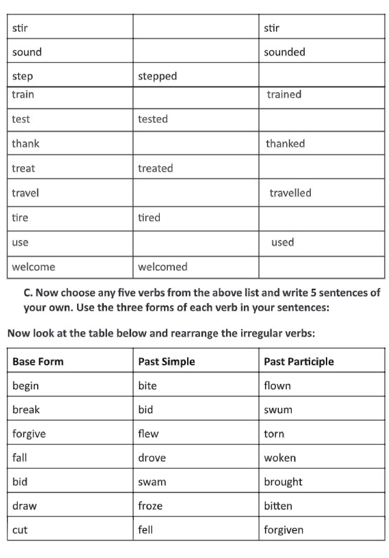
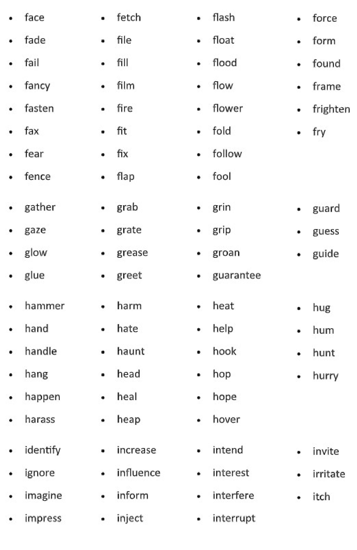
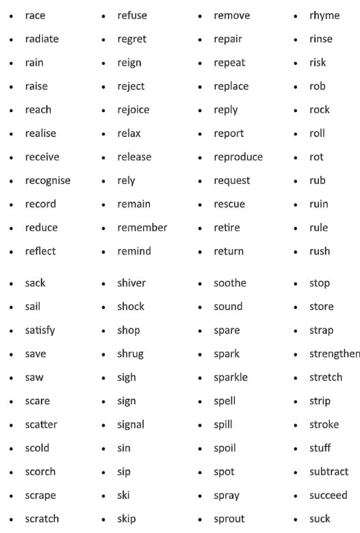
Below is a list of regular verbs which you should learn carefully.







Content added By