

Read the following examples.
Liza has lost her pen. She is looking for it. She says:
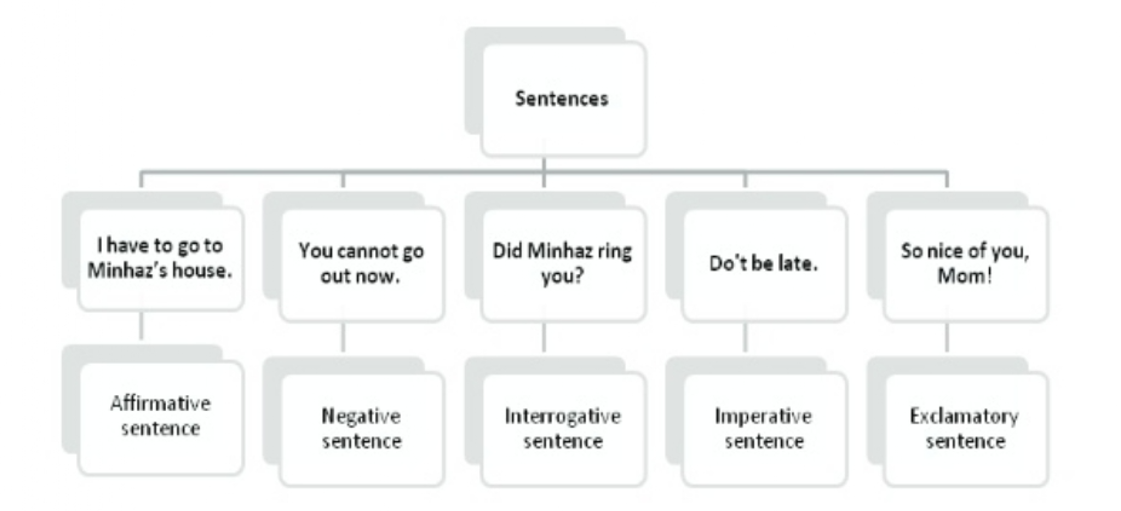
I have lost my ball point pen.
I cannot find it anywhere. Have you seen my pen?
Oh, how absentminded I am!
I kept it in my drawer.
If anyone gets it, please give it back
Each of these examples has a number of words arranged in a proper order and the words are arranged in a sequence that makes a complete sense.
Activity 1
Now read the following text and fill in the gaps to define what a sentence is. A sentence is a group of ______ with at least a _______ and a _______ A sentence has a complete ________.
Types of sentences
Now read the following dialogue between a son and a mother.
Son : Hi Mom!
Mom: Hi dear!
Son : Mom, I have to go to Minhaz's house now.
Mom: No, it is almost dusk. You cannot go out now.
Son: Please, mom. His father is sick. We have to take him to a hospital.
Mom: Oh, I see. Did Minhaz ring you?
Son: Yes, Mom.
Mom: Okay. Go then, but don't be late.
Son : So nice of you, mom!
Mom: Go. Hurry up and take care.
Son : Bye, Mom.
Mom: Bye, dear.
Read the following chart which shows some of the sentence types with one example of each type.
Activity 2
Follow the examples of sentence types and write a couple of sentences for each type.
Affirmative : ________________________________________________
: ________________________________________________
Negative : _________________________________________________
: _________________________________________________
Interrogative : ______________________________________________
: _________________________________________________
Imperative : _______________________________________________
: _________________________________________________
Exclamatory: ______________________________________________
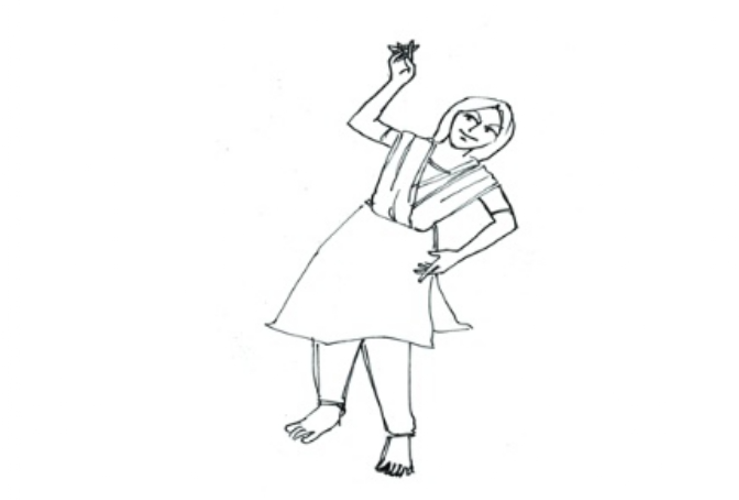
Tonusree is Alfaz's classmate. She is a good dancer. She also sings well. This year she is going to take part in Khulna district level dance competition. She wants to be the champion there.
The above sentences are positive statements. These types of sentences tell about a person or a thing. These are called affirmative sentences. An affirmative sentence needs
A subject + linking verb + complement
Tonusree is Alfaz's classmate
She is a good dancer.
Subject + intransitive verb
She also sings well
Subject + transitive verb + object
She wants to be the champion there.
Activity 3
Read the text below and underline the subject and verbs. Make a list of the verb types used here.
Boby's best friend is Talha. Talha is not the first boy in the class. Yet Boby likes him. Talha's language is very good. He speaks in perfect Bangla. He draws good cartoons. He is also a genius in computer games. Talha is a cricket player too. He likes fielding. Everyday Talha and Boby share tiffin. They like to sit together but often their teachers ask them to sit apart. Only the science teacher allows them to sit together. They both like her a lot.
Now write five affirmative sentences about your parents.
Read the text below and notice the sentences in bold:
Alfaz is a student of Tarar Mela School. He lives in a small town and doesn't like big cities. He thinks that big cities do not allow people to grow properly. Alfaz likes open fields, rivers, and nature. He is not allured by the big buildings and colourful lights of the cities. He likes the fresh foods and the known faces in his town. I have been Alfaz's friend from my childhood. We have many things in common. I also do not like city life that much. We have another interesting similarity. We are not cricket fans. We like football.
The text above has examples of negative sentences written in bold words.
Negative sentences are used to express
- dislikes : He lives in a small town and doesn't like big cities.
- disapproval : Big cities do not allow people to grow properly.
- disagreement
: Alam is a very naughty boy.
: Sorry, he is not a naughty boy. I found him very
:sober and gentle. - : Are you okay now?
: Not exactly. I can't walk any more.
How to make negative sentences?
Subject + auxiliary or supporting verb+ not + action verb +.... (He doesn't like big cities.)
Subject + be verb+ not + ____ (He is not a naughty boy.)
Subject + modal +not + ____ (I can't walk anymore.)
Activity 1
Write 2 sentences describing your own dislikes.
1. _________________________________
2._________________________________
Now write another two sentences describing your father/mother's disliking.
1. _______________________________
2._______________________________
Activity 2
Read the text below and fill in the gaps in it with an appropriate word from the box.
| didn't | won't | doesn't | am not |
| hasn't | couldn't | is still not | didn't |
Akash is my best friend. He ________ come to school for last few days. I came to know that he is sick. I _______ go to see him as my house is far away from his. I phoned his brother but he _______ respond. Maybe he was busy. Akash ______ okay. My friend Taposh lives near Akash's house. I will give Taposh some story books for Akash. I _______ feeling good in absence of my best friend. If he _______ come round soon, I go to the school picnic. I need to tell Akash that we have a new teacher in our school. I'm sure Akash _______ see her before.
Note: Both affirmative sentences and negative sentences fit to the category of assertive sentence. An assertive sentence makes a statement about some person, thing or event. It may be both positive and negative statement.
Read the conversation between the son and the mom after he returns from hospital and look at the queries she makes.
Mom: Hi dear. How is Mr. Abed now?
Son Oh, he is much better.
Mom: What happened to him?
Son: He was feeling restless. He had suffocation as well.
Son: When did the doctor see him?
Son: Immediately after he was taken to the hospital. A couple of hours ago.
Mom Is he still at the hospital?
Son Yes, he is and will be there for next 24 hours.
Mom: Does he have any pain in the chest?
Mom: Yes, a little.
The bold sentences are asking for some information. These are called interrogative sentences. A note of interrogation (?) is used at the end of an interrogative sentence. These sentences have the following attributes:
a) The be verb (in case of state verbs) or auxiliary verb (in case of action verbs) comes before the subject.
e.g. Is he still at the hospital? (Be verb before the subject)
Does he have any pain in the chest? (Auxiliary verb before the subject)
b) The sentence starts with either the auxiliary verb or 'wh' words (who, which what, when, whom, how, whose, why)
e.g. When did the doctor see him?
Note: when a question begins with a be verb or an auxiliary verb, that is a yes/no question. When a question begins with a wh-word, that is an information question or wh-question.
Activity 1
Read the following interview. Make questions for each statement.
1. ____________________?
2. I'm Monica. Monica Gonzalej.
3. __________________
4. I'm from Meherpur.
5.__________________ ?
6. Oh, I'm from Amjhupi.
7. _________________ ?
8. Only a week ago.
9. _________________ ?
10. My family has moved to this city due to my father's transfer.
11. __________________?
12. Yap, many times. I have some relatives here.
13. __________________ ?
14. No, you are my first friend.
Activity 2
Suppose you are going to interview one of your friends regarding his family members. Make five wh-questions and another 5 yes/no question for him/her.
1. ____________________________________
2.____________________________________
3.____________________________________
4.___________________________________
5.___________________________________
6.___________________________________
7.___________________________________
8.___________________________________
9.__________________________________
10.__________________________________
Read the text and answer the questions below it:
Dear students, silence please. Look at me. Try to guess what I want to tell you by my body language. Please keep silent. Now go straight and left. Cross two blocks. Turn right. Find out the red building. Speak to the security people there. Tell them that you are from Modhupur High School. Show them this paper if they ask you to prove your identity. Don't enter inside until they ask you to do that and don't lose this paper, please.

a. How does each sentence begin?
b. What is the purpose of these sentences?
In the above sentences, someone asks the listener to do something. These are imperative sentences. The imperative sentences begin with a verb in the base form. To make negative sentences using imperative you need to begin the sentence with don't and then use the verb. If the sentence is for request, use please at the beginning or in the end with a comma (,).
Imperatives sentences are used to give commands, instructions, advice, or make requests.
Activity 1
Here is a recipe for making orsaline. Each sentence needs a verb at the beginning. Choose them from the verbs given in the box and write them in the blank spaces.
| stir | pour | add | take | don't add |
_________ a clean jug.
_________ two glasses of boiled water with normal temperature in it.
_________ a handful of sugar and a pinch of salt.
_________ with a clean spoon.
_________ anything else.
Activity 2
Give the recipe for (a) boiled egg and (b) making an omelet. Add at least one negative sentence in imperative.
| Boiled egg | Omelet |
| 1. | 1. |
| 2. | 2. |
| 3. | 3. |
| 4 | 4 |
| 5. | 5. |
| 6. | 6. |
| 7. | 7. |
Activity 3
Suppose you meet a new person in front of your home. The person would like to go to your school but she doesn't know how to go. Give proper directions. Tell her at least two things not to do.
Read the following sentences.
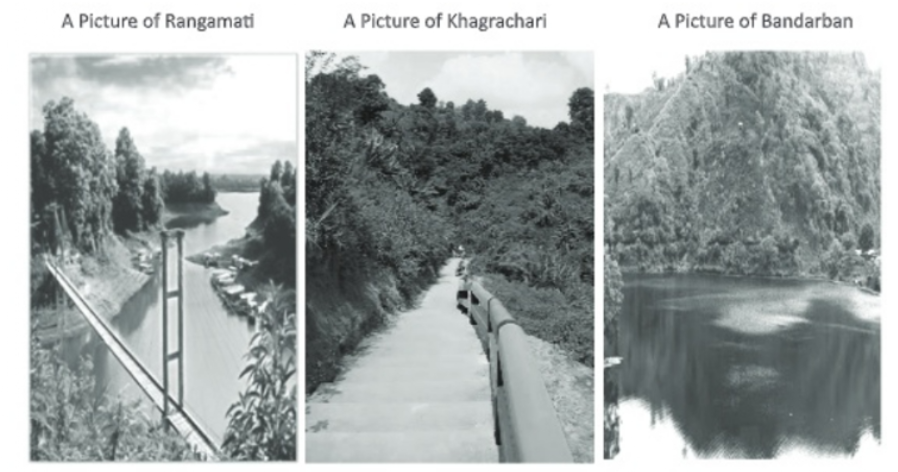
Steve Ansell is a tourist. He is visiting Bangladesh and now travelling Rangamati, Khagrachari, and Bandarbans. Yesterday he went to Nilachal and Chimbuk Pahar (hill). On the way he was surprised to see the floating clouds on the top of the hills and trees around. Many times he uttered, "Wow! What a great surprise! What a fantastic view!" Steve has taken many snapshots of the natural beauties of Bangladesh. Many times he showed me the photographs taken from Rangamati Lake and told me, "How wonderful your country is!" He added Bangladesh is truly called 'The beautiful Bangladesh'. Steve will explore Khagrachari tomorrow.
The underlined sentences in the text above are examples of exclamatory sentences. All sentences express Steve's excitement to see the natural beauty of Bangladesh. That is exactly what exclamatory sentences are used for. These sentences usually start with 'how' or 'what'. A note of exclamation (!) is used at the end of these sentences.
If you begin your sentence with 'how, then an adjective follows the word.
Eg. "How wonderful your country is!" (How + adjective+subject+verb)
If you begin your sentence with 'what', then a noun follows.
e.g. What a great surprise! (what+ noun+subject+verb) (meaning What a great surprise it is!)
b Sometimes we use some short exclamatory words at the beginning of these sentences.
Examples
Hurray! Our school football team has won the match.
Damn! They have scored another goal!
Alas! His father is no more.
Oh dear! Very sorry to hear your distress. I'm sure you will be okay soon.
Gosh! These kids will make me mad.
Activity 1
Here are some situations. Read them and write how you are going to express your surprise or excitement in these situations.
Your favourite cricketer has scored a century.
______________________________
You are surprised to see the beauty of St. Martins Island.
______________________________
You hear any interesting news.
______________________________
You read a book and is impressed by a character.
______________________________
Your friend has broken his leg in an accident.
______________________________
You are sympathetic to the misery of a friend.
______________________________
Your brother saved a baby from an accident by risking own life.
_______________________________
Read more