

উত্তরঃ

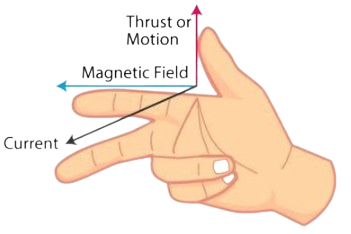
ফ্লেমিং-এর ডান হাত নিয়ম ব্যবহার করা হয় তড়িৎচৌম্বকীয় আবেশ (Electromagnetic Induction) থেকে উৎপন্ন তড়িৎ প্রবাহের দিক নির্ণয়ের জন্য। যখন কোনো পরিবাহক তারকে একটি চৌম্বক ক্ষেত্রে (magnetic field) সরানো হয়, তখন তারে একটি induced emf (এবং কারেন্ট) উৎপন্ন হয়।

ডান হাত নিয়ম :

ডান হাত প্রসারিত করে-

  • অঙ্গুলি (Thumb) → পরিবাহকের গতি বা motion এর দিক নির্দেশ করবে।
  • তর্জনী (Forefinger) → চৌম্বক ক্ষেত্রের দিক নির্দেশ করবে (North → South)।
  • মধ্যমা (Middle finger) → induced current (emf)- এর দিক নির্দেশ করবে।

অর্থাৎ Motion → Field → Current এই ক্রমে তিনটি আঙ্গুল পরস্পরের লম্বভাবে প্রসারিত করলে বর্তমানের দিক নির্ণয় করা যায়।

Md Zahid Hasan
Md Zahid Hasan
9 months ago
উত্তরঃ

মাইকেল ফ্যারাডে ১ম সূত্রানুসারে, যদি কোনো বন্ধ current loop-এর মধ্য দিয়ে গমনকারী চৌম্বক ফ্লাক্স (φ) সময়ের সাথে পরিবর্তিত হয়, তবে লুপে একটি induced emf (E) উৎপন্ন হবে।

ধরা যাক, একটি চুম্বক একটি কয়েলের দিকে অগ্রসর হচ্ছে। এখন দুটি সময়কে বিবেচনা করি- T1 এবং T2  

সময় T1-এ ফ্লাক্স লিংকেজ: Nφ1

সময় T2-এ ফ্লাক্স লিংকেজ: Nφ2

ফ্লাক্স লিংকেজের পরিবর্তন, Δ(Nφ)=Ν φ2 -φ1

এখন, ধরা যাক পরিবর্তনটি হলো, φ= φ2 -φ1

তাহলে, ফ্লাক্স লিংকেজের মোট পরিবর্তন হবে: Δ(Nφ)=Nφ

Flux linkage-এর পরিবর্তনের হার = Nφ /t

ডেরিভেটিভ নিলে পাই, dNφdt=Ndφdt

মাইকেল ফ্যারাডে ২য় সূত্রানুসারে, একটি কয়েলে প্রবর্তিত (induced) emf = Flux linkage-এর পরিবর্তনের হার

অতএব, e = - Ndφdt

Md Zahid Hasan
Md Zahid Hasan
9 months ago
59

Related Question

View All
উত্তরঃ

Step-by-step Solution:

Step 1: Calculate Thevenin's Equivalent Voltage (\(V_{th}\))

Terminals X-Y are open-circuited, so no current flows through the branch containing the \(10\,\Omega\) resistor and the \(X_C = 10\,\Omega\) capacitor connected to terminal X.

Therefore, the open-circuit voltage \(V_{th}\) across terminals X-Y is equal to the voltage drop across the parallel branch \((3 + j14)\,\Omega\).

Using the Voltage Divider Rule:

\(V_{th} = V_s \times \frac{3 + j14}{-j10 + (3 + j14)}\)

\(V_{th} = 100 \times \frac{3 + j14}{3 + j4}\)

Multiplying the numerator and denominator by the complex conjugate of the denominator \((3 - j4)\):

\(V_{th} = 100 \times \frac{(3 + j14)(3 - j4)}{3^2 + 4^2}\)

\(V_{th} = 100 \times \frac{9 - j12 + j42 + 56}{25}\)

\(V_{th} = 100 \times \frac{65 + j30}{25}\)

\(V_{th} = 4 \times (65 + j30) = 260 + j120\text{ V}\)

In polar form:

\(|V_{th}| = \sqrt{260^2 + 120^2} = 286.36\text{ V}\)

\(\theta = \tan^{-1}\left(\frac{120}{260}\right) = 24.78^\circ\)

\(V_{th} = 286.36 \angle 24.78^\circ\text{ V}\)


Step 2: Calculate Thevenin's Equivalent Impedance (\(Z_{th}\))

To find the equivalent impedance \(Z_{th}\), deactivate the independent voltage source by replacing it with a short circuit.

Looking back into terminals X-Y, the \(-j10\,\Omega\) capacitor is in parallel with the \((3 + j14)\,\Omega\) branch, and this combination is in series with the \((10 - j10)\,\Omega\) branch leading to terminal X.

\(Z_{th} = (10 - j10) + \left[ (-j10) \parallel (3 + j14) \right]\)

Calculating the parallel portion (\(Z_p\)):

\(Z_p = \frac{-j10 \times (3 + j14)}{-j10 + 3 + j14} = \frac{140 - j30}{3 + j4}\)

Multiplying by the conjugate \((3 - j4)\):

\(Z_p = \frac{(140 - j30)(3 - j4)}{3^2 + 4^2} = \frac{420 - j560 - j90 - 120}{25} = \frac{300 - j650}{25} = 12 - j26\,\Omega\)

Now, substitute \(Z_p\) back to calculate \(Z_{th}\):

\(Z_{th} = (10 - j10) + (12 - j26) = 22 - j36\,\Omega\)

In polar form:

\(|Z_{th}| = \sqrt{22^2 + (-36)^2} = 42.19\,\Omega\)

\(\theta = \tan^{-1}\left(\frac{-36}{22}\right) = -58.57^\circ\)

\(Z_{th} = 42.19 \angle -58.57^\circ\,\Omega\)


Final Answer:

The Thevenin's equivalent circuit across terminal X-Y consists of:

      
  • Thevenin's Voltage (\(V_{th}\)): \(260 + j120\text{ V}\) or \(286.36 \angle 24.78^\circ\text{ V}\)
  •   
  • Thevenin's Impedance (\(Z_{th}\)): \(22 - j36\,\Omega\) or \(42.19 \angle -58.57^\circ\,\Omega\)
Satt AI
Satt AI
1 day ago
739
উত্তরঃ

Maximum Power Transfer Theorem :

In electrical engineering, the maximum power transfer theorem states that, to obtain maximum external power from a power source with internal resistance, the resistance of the load must equal the resistance of the source as viewed from its output terminals.

সৌরভ
সৌরভ
2 years ago
728
উত্তরঃ

For t<0, the switch is closed.

Capacitor acts as open to DC.

Voltage across the capacitor,

     v(0-)= {(12||4)×V}÷{(12||4)+6} = 8VFor t=0, the switch is opened,Voltage across the Capacitor cannot change instantaneously,So, v(0-)= v(0) = 8VAt t>0, The capacitor is discharging.Rth = (12||4) = 3 ohmC= 1/6 FTime constant, Π = Rth×C = 0.5 So, v(t) = v(0)e-t/Π  = 8e-t/0.5 =8e-2t V (Ans.)

Md Shoyaeb
Md Shoyaeb
1 year ago
749
শিক্ষকদের জন্য বিশেষভাবে তৈরি

১ ক্লিকে প্রশ্ন, শীট, সাজেশন
অনলাইন পরীক্ষা তৈরির সফটওয়্যার!

শুধু প্রশ্ন সিলেক্ট করুন — প্রশ্নপত্র অটোমেটিক তৈরি!

প্রশ্ন এডিট করা যাবে
জলছাপ দেয়া যাবে
ঠিকানা যুক্ত করা যাবে
Logo, Motto যুক্ত হবে
অটো প্রতিষ্ঠানের নাম
অটো সময়, পূর্ণমান
প্রশ্ন এডিট করা যাবে
জলছাপ দেয়া যাবে
ঠিকানা যুক্ত করা যাবে
Logo, Motto যুক্ত হবে
অটো প্রতিষ্ঠানের নাম
অটো সময়, পূর্ণমান
অটো নির্দেশনা (এডিটযোগ্য)
অটো বিষয় ও অধ্যায়
OMR সংযুক্ত করা যাবে
ফন্ট, কলাম, ডিভাইডার
প্রশ্ন/অপশন স্টাইল পরিবর্তন
সেট কোড, বিষয় কোড
অটো নির্দেশনা (এডিটযোগ্য)
অটো বিষয় ও অধ্যায়
OMR সংযুক্ত করা যাবে
ফন্ট, কলাম, ডিভাইডার
প্রশ্ন/অপশন স্টাইল পরিবর্তন
সেট কোড, বিষয় কোড
এখনই শুরু করুন ডেমো দেখুন
৫০,০০০+
শিক্ষক
৩০ লক্ষ+
প্রশ্নপত্র
মাত্র ১৫ পয়সায় প্রশ্নপত্র
১ ক্লিকে প্রশ্ন, শীট, সাজেশন তৈরি করুন আজই

Complete Exam
Preparation

Learn, practice, analyse and improve

1M+ downloads
4.6 · 8k+ Reviews