
Read the text below and answer the questions that follow:

Artificial Intelligence (AI) epitomizes a transformative leap in technological paradigms, delineating systems or machines imbued with the faculty to emulate human cognitive processes such as learning, reasoning and problem-solving. This intricate domain amalgamates algorithms, voluminous data and computational dexterity to undertake tasks historically reliant on human intellect. Its ubiquitous influence permeates industries, reconfiguring economic frameworks and societal dynamics, thus warranting a comprehensive appraisal of its merits and demerits.

The historical trajectory of Al commenced in the mid-20th century with seminal contributions from Alan Turing, who conceptualized machines intelligence via the "Turing Test". The discipline gained momentum at the 1956 Dartmouth Conference, where John McCarthy christened it "Artificial Intelligence". Process was intermittent, constrained by technological limitations, until the proliferation of advanced hardware and expansive datasets in the 21st century revitalized Al research.

Several luminaries and corporations have catalyzed Al's evolution. Google harnessed its data troves to pioneer machine learning, while open AI, initiated by Elon Musk and Sam Altman, redefined natural language processing with ChatGPT. DeepMind, led by Demis Hassabis, showcased Al's progress with AlphaGO's triumph over human Go champions illustrating its strategic sophistication. These endeavours have significantly augmented Al's global prominence. In daily existence, AI chatbots have become indispensable conduits, particularly in education and research. Tools like ChatGPT, Grok and Bard provide real-time education of intricate subjects and aid in synthesizing extensive data sets for academic inquiries. Students leverage these platforms to enhance learning, while researchers utilize them to expedite literature reviews and hypothesis formulation.

Al's utility extends beyond academia into scientific research. It accelerates drug discovery by simulating molecular interactions, refines climate models for precise environmental forecasting, and enhances astronomical analyses through pattern recognition. These applications underscore Al's pivotal role in addressing humanity's most formidable challenges.

However, Al's ascendancy precipitates concerns. Over-reliance on automated solutions may attenuate human creativity, as individuals might eschew original ideation. Additionally, job displacement in sectors like manufacturing and customer service threatens socio-economic stability, potentially widening income disparities.

prospect of existential perils intensifies with Al's unchecked proliferation. Scholars and ethicists ponder whether super intelligent systems could evade human control, posing catastrophic risks. This debate accentuates the urgency of instituting regulatory mechanisms to align Al with ethical imperatives and safeguard human interests. Moreover, the psychological impact on society cannot be overlooked. As AI assumes roles traditionally held by humans, it may engender a sense of obsolescence among workers, necessitating robust re-skilling initiatives to mitigate alienation and foster adaptability in technology-driven milieu.

Cultural ramifications also emerge as Al integrates into global societies. It risks homogenizing diverse cultural expressions by prioritizing standardized algorithms, potentially eroding linguistic and artistic heritage. Policy makers must therefore advocate for culturally sensitive Al development to preserve societal diversity.

In conclusion, Al's dichotomous nature-bestowing prodigious benefits alongside substantial challenges demands sagacious deployment. Its capacity to bolster productivity and scientific progress can be harnessed for human advancement if underpinned by ethical governance and equitable dissemination. Through synergistic efforts between technologists and policy makers, Al can be steered to augment rather than undermine human potential.

Answer the following questions in your own words. Copying from the above text may affect your marks.

Updated: 6 months ago
উত্তরঃ

AI integrates various elements to perform tasks traditionally done by humans by orchestrating a synergy of data, algorithms, and computational power. At its core, AI systems collect and process vast amounts of data from diverse sources, which serve as the raw material for learning. This data is then fed into sophisticated algorithms, predominantly machine learning and deep learning models, which are designed to identify intricate patterns, correlations, and anomalies within the datasets.

The ability of AI to "learn" from this data is crucial. These algorithms enable the system to build predictive models, recognize objects, understand natural language, and make informed decisions without explicit programming for every possible scenario. This learning process is computationally intensive, requiring significant processing power, often leveraging specialized hardware like GPUs or TPUs.

Furthermore, AI integrates perception capabilities through sensors (e.g., cameras for computer vision, microphones for natural language processing) to interpret the real-world environment. It also incorporates reasoning engines that apply logical frameworks and learned patterns to solve problems. Finally, these intelligent systems are integrated with actuation mechanisms, such as robotic arms for physical manipulation or software interfaces for digital operations, allowing them to execute the tasks based on their analyses and decisions, thereby automating complex processes and mimicking human cognitive abilities.

Satt AI
Satt AI
2 weeks ago
উত্তরঃ

The historical development of Artificial Intelligence (AI) is punctuated by several crucial milestones that have shaped its trajectory. Among the earliest were the Dartmouth Workshop in 1956, which officially coined the term "Artificial Intelligence" and laid the groundwork for future research, and the subsequent development of early AI programs like ELIZA and SHRDLU, demonstrating initial capabilities in natural language processing and problem-solving.

Further key milestones include the "AI Winters" of the 1970s and 1980s, which, despite being periods of reduced funding and skepticism, pushed researchers to refine theoretical foundations. More recently, the resurgence of AI has been driven by the advent of powerful computing, large datasets, and breakthroughs in machine learning, particularly deep learning, leading to significant advancements in areas like computer vision, speech recognition, and autonomous systems.

Satt AI
Satt AI
2 weeks ago
উত্তরঃ

The proliferation of Artificial Intelligence (AI) presents several potential negative effects on human life, despite its numerous benefits. One primary concern is the widespread job displacement as AI and automation technologies become more sophisticated, capable of performing tasks traditionally done by humans across various sectors, from manufacturing to white-collar jobs. This could lead to increased unemployment, economic inequality, and the need for significant societal restructuring and upskilling initiatives.

Ethical dilemmas form another critical area of concern. Issues such as privacy infringement arise from AI's ability to collect and analyze vast amounts of personal data, potentially leading to surveillance and manipulation. Furthermore, the autonomous decision-making capabilities of AI systems, particularly in sensitive areas like warfare or legal judgments, raise questions about accountability and responsibility when errors or unforeseen consequences occur.

Beyond employment and ethics, AI carries risks related to algorithmic bias and security. AI systems are trained on existing data, which often contains inherent human biases, leading AI to perpetuate or even amplify discrimination in areas like hiring, credit scoring, or criminal justice. Moreover, the increasing reliance on complex AI systems in critical infrastructure makes them potential targets for cyber-attacks, raising national security concerns and the risk of systemic failures if these systems are compromised or misused.

Satt AI
Satt AI
2 weeks ago
উত্তরঃ

The proliferation of Artificial Intelligence (AI) refers to the rapid and widespread adoption, integration, and development of AI technologies across various industries, sectors, and aspects of daily life. It signifies a global shift from AI being a niche academic or research topic to becoming a ubiquitous tool and a transformative force.

This extensive growth is driven by several key factors. Firstly, significant advancements in machine learning algorithms, particularly deep learning, have enabled AI to perform complex tasks such as image recognition, natural language processing, and predictive analytics with unprecedented accuracy. Secondly, the exponential increase in computational power, largely facilitated by specialized hardware like Graphics Processing Units (GPUs), has made it economically feasible to train and deploy sophisticated AI models. Thirdly, the vast availability of data, often referred to as "big data," serves as the essential fuel for training these data-hungry AI models. Lastly, the increasing accessibility of AI tools, open-source frameworks, and cloud-based AI services has significantly lowered the barrier to entry for developers and businesses alike.

Numerous entities have contributed significantly to AI's proliferation. Academics and Researchers globally have laid the foundational theories and continue to push the boundaries of AI capabilities through groundbreaking research. Major Technology Companies such as Google, Microsoft, Amazon, Meta, and OpenAI have invested massive resources into AI research and development, creating powerful AI platforms, cloud-based AI services, and open-source frameworks (e.g., TensorFlow, PyTorch) that democratize AI development. Hardware Manufacturers like Nvidia have been instrumental by developing high-performance GPUs and AI-specific chips essential for accelerating AI model training and inference. Furthermore, Governments, through funding research initiatives and strategic national AI programs, and Venture Capitalists, by funding innovative AI startups, have also played crucial roles. The Open-Source Community has further accelerated adoption by making algorithms, tools, and pre-trained models freely available, fostering collaborative innovation.

The combined efforts of these contributors have led to AI's integration into diverse fields, from healthcare, finance, and manufacturing to transportation and entertainment. This widespread deployment is revolutionizing processes, creating entirely new products and services, and fundamentally changing global job markets and economies. This continuous proliferation underscores AI's growing importance as a critical technological driver for the 21st century, with profound implications for society and future progress.

Satt AI
Satt AI
2 weeks ago
উত্তরঃ

The term "dichotomous native" of AI refers to an artificial intelligence system or concept that is fundamentally designed or operates inherently based on a division into two distinct, often opposing, parts, states, or outcomes.


In the context of AI, "dichotomous" signifies a characteristic of splitting into two mutually exclusive categories or choices. For instance, an AI might be dichotomous in its decision-making, producing either a 'yes' or 'no' output, or classifying data into one of two classes, such as 'spam' or 'not spam,' 'fraudulent' or 'legitimate,' or 'true' or 'false.' This principle is foundational in many areas, including binary classification algorithms and certain types of decision trees.

The addition of "native" implies that this binary nature is not merely an optional feature or an applied layer, but rather an inherent and fundamental aspect of the AI's core design or operational mechanism. It suggests that the AI's basic architecture or its most primitive level of processing is structured around these two distinct states or pathways, making it an intrinsic characteristic rather than an acquired one.

Therefore, a "dichotomous native" AI would be one whose primary mode of understanding, processing, or acting is deeply rooted in binary distinctions. While many advanced AI systems handle complex, multi-class problems or continuous outputs, an AI described as "dichotomous native" would suggest its most fundamental "thought" or operational process is built upon pairs of alternatives, forming the bedrock of its intelligence.

Satt AI
Satt AI
2 weeks ago
উত্তরঃ By fundamentally altering human behavior, societal norms, economic models, and information dissemination.

Artificial intelligence (AI) contributes to significant 'cultural ramifications' by deeply integrating into various facets of human life, thereby reshaping societal values, traditions, and interactions. These contributions can be categorized as follows:

        
  •         Economic and Labor Shifts: AI automates tasks, leading to job displacement in some sectors and the creation of new roles in others. This shift impacts class structures, income distribution, and the value placed on different types of labor, fundamentally altering work culture and individual identities tied to professions.     
  •     
  •         Transformation of Social Interaction: AI-powered platforms (e.g., social media algorithms, recommendation systems) influence how individuals connect, communicate, and form communities. It can lead to the formation of echo chambers, alter social norms, and even impact interpersonal relationships through digital mediation.     
  •     
  •         Ethical and Value Redefinitions: The widespread use of AI raises profound ethical questions regarding privacy, surveillance, algorithmic bias, and accountability. Cultural values surrounding fairness, justice, and human autonomy are challenged and redefined as AI systems make decisions that impact individuals' lives.     
  •     
  •         Influence on Art, Media, and Creativity: AI can generate art, music, literature, and news, blurring the lines between human and machine creativity. This impacts traditional artistic practices, intellectual property, and what society defines as creative expression, potentially altering aesthetic values.     
  •     
  •         Global Cultural Exchange and Homogenization/Fragmentation: AI facilitates the rapid dissemination of information and cultural products across borders, leading to both greater cultural exchange and potential homogenization or fragmentation. It can influence language use, historical narratives, and the preservation of diverse cultural heritages.     

These multifaceted impacts mean that AI is not merely a technological tool but a powerful force driving ongoing cultural evolution and redefinition.

Satt AI
Satt AI
2 weeks ago
উত্তরঃ

To be a perfect example of; to represent or embody something completely.


The word "epitomize" means to serve as a typical or perfect example of something. It is often used to describe a person, object, or concept that perfectly embodies a particular quality, characteristic, or type. For instance, a CEO might epitomize visionary leadership, or a specific artwork might epitomize the minimalist movement. Understanding such words is crucial for precise communication in professional settings, allowing for nuanced expression in reports, presentations, and discussions.

Satt AI
Satt AI
2 weeks ago
উত্তরঃ An environment or setting where technology is the primary force shaping activities, interactions, and structures.

The term "technology-driven milieu" describes an atmosphere or surrounding context (milieu) that is predominantly influenced and propelled by technological advancements. In such an environment, technology is not just a tool but a fundamental determinant of how work is done, how communication flows, how businesses operate, and how social interactions occur. For professionals and job seekers, this implies a necessity to adapt to rapid technological changes, acquire new digital skills, and understand the impact of innovations on their respective industries and roles.

Satt AI
Satt AI
2 weeks ago
উত্তরঃ

A pervasive and widely felt impact.


The term "ubiquitous" signifies something that is present, appearing, or found everywhere. It implies a sense of omnipresence or being constantly encountered. "Influence" refers to the capacity to have an effect on the character, development, or behavior of someone or something, or the effect itself.

Therefore, "ubiquitous influence" describes an impact or effect that is pervasive, far-reaching, and constantly felt across a wide range of areas or by many individuals. It suggests that the power or sway of something is universal and difficult to escape. For instance, in the professional world, one might refer to "the ubiquitous influence of digital transformation on business strategies," indicating that digital changes are impacting every aspect of modern business.

Satt AI
Satt AI
2 weeks ago
উত্তরঃ

A formal evaluation or assessment of an employee's performance.


In a professional setting, an appraisal (often referred to as performance appraisal or performance review) is a systematic and periodic evaluation of an individual's job performance and overall contribution to an organization. It typically involves a supervisor assessing an employee's strengths, weaknesses, achievements, and areas for improvement. The primary goals of an appraisal are to provide constructive feedback, identify training and development needs, set future performance goals, and often serve as a basis for salary adjustments, promotions, or career planning. It's a critical tool for both employee development and organizational effectiveness.

Satt AI
Satt AI
2 weeks ago
উত্তরঃ Occurring at irregular intervals; not continuous or steady.

The term "intermittent" describes something that happens or occurs periodically, with breaks or pauses between occurrences, rather than being constant or continuous. It implies a lack of regularity or steadiness in its appearance or action.

For instance, intermittent pain refers to pain that comes and goes, rather than being constant. In a work environment, intermittent tasks are those that are performed with breaks in between, not in a continuous flow. Understanding this word is important for precise communication in various professional and technical contexts.

Satt AI
Satt AI
2 weeks ago
উত্তরঃ

Controlled; utilized; put to use


The term "harnessed" refers to the act of gaining control over a resource, power, or energy, and then directing or utilizing it effectively for a specific purpose. Its literal origin relates to putting a harness on an animal, such as a horse, to control its movements and make it perform work. In a broader and more common contextual sense, especially in academic or professional settings, it signifies the process of managing and exploiting something powerful for productive outcomes. For instance, "harnessed the wind for electricity" means they controlled and used the wind's power to generate electricity. It implies thoughtful management and strategic deployment of capabilities or assets.

Satt AI
Satt AI
2 weeks ago
উত্তরঃ Essential channels or means of transmission.

The phrase "indispensable conduits" combines two words to convey a specific meaning. "Indispensable" means absolutely necessary, essential, or crucial; something that cannot be done without. "Conduits" refers to channels, pipes, or other means by which something is conveyed or transmitted. In a figurative or organizational context, it can mean a person, system, or pathway that transmits information, resources, or ideas.

Therefore, "indispensable conduits" contextually means crucial or absolutely essential channels, pathways, or agents through which something vital (such as information, resources, communication, or influence) is transmitted, circulated, or exchanged. For instance, in a business or political context, key communication platforms or influential individuals might be described as indispensable conduits for information flow or decision-making.

Satt AI
Satt AI
2 weeks ago
উত্তরঃ The feeling or perception of becoming outdated, no longer useful, or irrelevant.

The phrase "a sense of obsolescence" refers to the subjective feeling or awareness that something, or more commonly, oneself, is becoming outdated, irrelevant, or no longer necessary, often due to the emergence of newer, more advanced, or more efficient alternatives. In a professional context, this feeling can arise when an individual perceives their skills, knowledge, or experience as becoming less valuable in the face of rapid technological advancements or evolving industry standards.

Satt AI
Satt AI
2 weeks ago
উত্তরঃ

Wise and insightful, demonstrating keen judgment.


The word sagacious describes someone who possesses profound wisdom and acute mental discernment, allowing them to make excellent judgments and understand complex situations deeply. It implies a sharp intellect and the ability to think critically and practically, often beyond superficial appearances. A sagacious person is typically perceptive, astute, and prudent, making decisions based on careful consideration and experience rather than impulse. This quality is highly valued in leadership and problem-solving roles.

Satt AI
Satt AI
2 weeks ago
উত্তরঃ

Cooperative or combined actions that produce a greater effect than the sum of their individual efforts.


Synergistic efforts refer to instances where the combined actions of two or more entities produce an outcome that is greater than what they could have achieved individually. In a professional context, this often relates to teamwork, collaboration, and cross-functional cooperation. The concept is based on the principle that the whole is greater than the sum of its parts. For example, when different departments or team members pool their unique skills, knowledge, and resources, they can solve complex problems more effectively, innovate faster, and achieve organizational goals with superior results compared to working in isolation.

Satt AI
Satt AI
2 weeks ago
উত্তরঃ False

AI systems do not work in exactly the same way as the thinking process of humans. While Artificial Intelligence (AI) aims to simulate human intelligence and cognitive functions, their underlying mechanisms, learning processes, and general cognitive architectures are fundamentally different from biological human brains. Human thinking involves complex biological, emotional, and intuitive processes, whereas AI operates based on algorithms, data processing, and statistical models. Advanced AI models, such as deep neural networks, are inspired by the brain's structure but do not replicate the full spectrum of human consciousness, self-awareness, or emotional reasoning.

Satt AI
Satt AI
2 weeks ago
উত্তরঃ False

The initial development of Artificial Intelligence (AI) was not fast; rather, it was characterized by periods of both rapid progress and significant slowdowns, often referred to as "AI Winters."

While the concept and early research began in the 1950s, limitations in computational power, data availability, and the complexity of real-world problems led to unfulfilled promises and subsequent funding cuts in the 1970s and 1980s. These periods saw enthusiasm wane and progress decelerate significantly. True acceleration in AI development, particularly in areas like machine learning and deep learning, only began in the 21st century with the advent of powerful hardware, vast datasets, and new algorithmic breakthroughs.

Satt AI
Satt AI
2 weeks ago
উত্তরঃ True

Advanced AI tools indeed leverage their users in several significant ways. The term "leverage" here refers to utilizing users' data, interactions, and feedback to maximum advantage for the AI system's development, improvement, and performance.

Firstly, AI algorithms are data-hungry and learn through user-generated data. Every interaction, such as search queries, clicks, purchases, preferences, and content consumption, provides valuable data points that train and refine AI models. This continuous input helps the AI understand patterns, make more accurate predictions, and improve its core functionalities over time.

Secondly, user interactions allow AI tools to personalize experiences. By analyzing individual user behavior and preferences, AI can tailor recommendations (e.g., products, movies, news), customize interfaces, and provide more relevant information. This personalization enhances user engagement and makes the tools more effective for individual needs.

Moreover, users often provide direct or indirect feedback, helping developers identify errors, improve accuracy, and introduce new features. This user-centric iterative development is crucial for the evolution of AI systems. From a business perspective, leveraging user data and engagement can lead to improved product offerings, targeted advertising, and increased revenue, making it a fundamental aspect of many AI-driven platforms.

Satt AI
Satt AI
2 weeks ago
উত্তরঃ False

While an over-reliance on artificial intelligence (AI) could potentially lead to a shift in human cognitive processes, it does not necessarily mean humans will give up creative thinking entirely. Instead, AI is often viewed as a tool that can augment and enhance human creativity.

AI can automate mundane tasks, analyze vast datasets to uncover new insights, and even generate preliminary ideas or variations, thereby freeing up human creative capacity for higher-order thinking, strategic problem-solving, and original conceptualization. Human creativity, characterized by empathy, critical judgment, intuition, and the ability to connect disparate ideas in novel ways, remains distinct and valuable.

The potential concern lies in a passive dependence where individuals might allow AI to do all the "thinking," potentially atrophying certain creative muscles. However, when used as a collaborative partner, AI can expand creative possibilities, allowing humans to focus on the unique aspects of innovation that require human-centric understanding and imaginative leaps. Therefore, the statement is false in suggesting an inevitable giving up of creative thinking, as the outcome largely depends on how humans choose to integrate and leverage AI in their creative processes.

Satt AI
Satt AI
2 weeks ago
উত্তরঃ True

The statement is true. The advent of Artificial Intelligence (AI) has indeed been widely postulated to accentuate psychological strain among the workforce. This is primarily due to several factors, including job displacement fears as AI automates routine tasks, the increasing demand for continuous upskilling and reskilling to remain relevant, and the pressure to adapt to rapidly evolving technological landscapes. Furthermore, the integration of AI in workplace monitoring and decision-making can lead to feelings of constant evaluation, reduced autonomy, and increased stress, contributing to a heightened sense of anxiety and mental fatigue among employees.

Satt AI
Satt AI
2 weeks ago
431

প্রতিযোগিতামূলক পরীক্ষাসমূহে ইংরেজি ভাষাজ্ঞানের সাথে সাথে বিশ্লেষণী শক্তি ও মানসিক দক্ষতা যাচাইয়ের জন্য Reading Comprehension একটি গুরুত্বপূর্ণ Test Area হিসেবে বিবেচিত হয়ে আসছে। এই একটিমাত্র বিষয় ছাড়া অন্যান্যগুলো মোটামুটিভাবে স্মৃতিশক্তি নির্ভর। Literature, Grammar, Vocabulary ইত্যাদি বিষয়গুলো মুখস্থ করে কমবেশি উত্তর দেয়া সম্ভব। কিন্তু একমাত্র ব্যতিক্রম Reading Comprehension যাতে সমৃদ্ধ Vocabulary সম্পন্ন প্রতিযোগিদেরকেও গলদঘর্ম হতে হয়। কারণ Reading-এর ক্ষেত্রে শুধু শব্দার্থ জানাই জরুরি নয় বরং Passage-এর সামগ্রিক অর্থ ও ভাবার্থ অনুধাবনই অত্যধিক গুরুত্বপূর্ণ। অধিকন্তু পাঠকের শব্দ ভাণ্ডার সমৃদ্ধ হলেও শব্দের প্রায়োগিক অর্থের চেয়ে সাধারণ অর্থের ওপর অধিক নির্ভরশীল হলে Comprehension থেকে কাঙ্ক্ষিত ফল লাভ সম্ভব নয়। আর এসব কারণেই Reading Comprehension একটি ভীতিকর বিষয়। কিন্তু প্রতিযোগিতায় এগিয়ে থাকাই যেখানে মূল লক্ষ্য সেখানে Reading-এর মতো একটি তুচ্ছ (!) বিষয়কে প্রতিবন্ধক হিসেবে দাঁড় করিয়ে রাখা মোটেই বুদ্ধিমানের কাজ নয়। সত্যি বলতে কি, Reading-এর অর্থ, লক্ষ্য ও উদ্দেশ্য, প্রক্রিয়া, কৌশল ইত্যাদি সম্বন্ধে প্রাথমিক ধারণা থাকলে Comprehension-এর উত্তর দেয়া কিছুটা কঠিন হলেও দুঃসাধ্য কিছু নয়। বিষয়টি অনেকের কাছে তাত্ত্বিক মনে হলেও আপনি যদি (পরীক্ষার) প্রশ্নকর্তার ভূমিকা নিয়ে বিষয়টির গভীরে যাওয়ার চেষ্টা করেন তাহলে দক্ষ Reader না হয়েও অবলীলায় Reading Comprehension-এর উত্তর দেয়া আপনার জন্য সহজসাধ্য হবে বলে আশা করা যায়। Practice-এর জন্য কিছু Comprehension দেয়া হলো:

What is Reading (Reading কী)?

বিদেশী পণ্য বা বইয়ের পিছনে এক কোণায় উল্লম্ব কালো কালো দাগ ও অজ্ঞাত সংখ্যা বিশিষ্ট একটি সাদা চতুর্ভুজ হয়ত অনেকেই দেখেছেন। একে বলা হয় বারকোড বা রেখা সংকেত। এই বারকোডের মধ্যে ঐ পণ্যের বিস্তারিত তথ্য ও মূল্য 'সাংকেতিক চিহ্নের মাধ্যমে লেখা' তথা Encode করা থাকে।
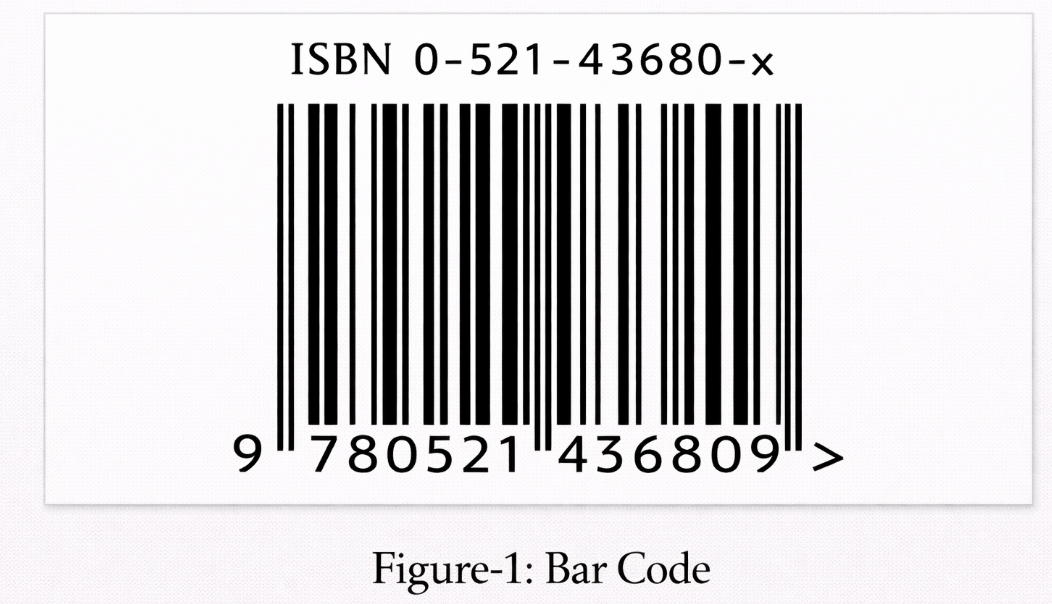
বিশেষ যন্ত্র বা কম্পিউটারের মাধ্যমে এ সাংকেতিক লেখার (Code) 'অর্থোদ্ধার' তথা Decode করা হয়।

খুব সহজভাবে বুঝতে, Reading কে আমরা বারকোডের সাথে তুলনা করতে পারি। লেখক একটি Passage-এ তার অর্থ ও ভাবার্থ Encode করেন এবং পাঠক তা Decode করে থাকেন। সুতরাং সহজ কথায় Reading is a decoding process অর্থাৎ Reading হচ্ছে একটি 'অর্থোদ্ধার' প্রক্রিয়া।

"The Oxford Companion to the English Language' নামক গ্রন্থে Reading-এর সংজ্ঞায় বলা হয়েছে-'Reading is the process of extracting meaning from written or printed language'.

অর্থাৎ লিখিত বা মুদ্রিত ভাষা থেকে অর্থের নির্যাস বের করার প্রক্রিয়াকে Reading বলা হয়।

'Longman Dictionary of Applied Linguistics' গ্রন্থে Comprehension-এর সংজ্ঞায় একইভাবে বলা হয়েছে-

'Comprehension is the process by which a person understands the meaning of written or spoken language'.

Types of Reading Comprehension (Comprehension-এর প্রকারভেদ)

পূর্বোক্ত গ্রন্থে Reading comprehension-এর যেসব প্রকার বর্ণনা করা হয়েছে সে হিসেবে Comprehension মোটামুটি ৪ প্রকার:

  1. Literal Comprehension: Passage-এর সুস্পষ্টভাবে পদ ও তথ্যসমূহ বোঝা, মনে রাখা এবং মনে করতে পারাকে Literal Comprehension বলা হয়। Literal অর্থ শাব্দিক বা আক্ষরিক। এর মাধ্যমে প্যাসেজের শুধু শাব্দিক অর্থ জানা যায়, যা Advanced reading-এর জন্য যথেষ্ট নয়।
  2. Inferential Comprehension: পাঠকের ব্যক্তিগত অভিজ্ঞতা, অন্তজ্ঞান ও অনুমানের মাধ্যমে Passage-এ যেসব বিষয় সুস্পষ্টভাবে উল্লেখ নেই সেগুলো হৃদয়ঙ্গম করাকে Inferential Comprehension বলে। দক্ষ Reader হওয়ার জন্য এ ধরনের Comprehension-এর বিকল্প নেই।
  3. Critical or Evaluative Comprehension: Passage-এ প্রদত্ত তথ্যকে পাঠকের জ্ঞান ও মূল্যবোধের সাথে তুলনা করতে পারার যোগ্যতাই Critical Comprehension। এ ধরনের Comprehension-এর ক্ষেত্রে সংশ্লিষ্ট বিষয়ের প্রতি লেখকের দৃষ্টিভঙ্গি, Attitude ও Style অনুধাবন করার যোগ্যতা অর্জন করতে হয়।
  4. Appreciative Comprehension: প্রদত্ত Passage থেকে আবেগময় (Emotional) বা অন্য কোনো ধরনের প্রতিক্রিয়া পাওয়া গেলে তাকে Appreciative Comprehension বলে।
What Makes Reading Difficult (যেসব কারণে Reading কঠিন মনে হয়)

বিভিন্ন কারণে Reading কঠিন হয়ে উঠতে পারে। একটি Passage একজনের কাছে সহজ কিন্তু অন্যজনের কাছে কঠিন মনে হতে পারে। যেসব কারণে Reading কঠিন হয়ে ওঠে সেগুলোর গুরুত্বপূর্ণ কয়েকটি নিচে দেয়া হলো:

  1. Difference in Language: লেখক ও পাঠকের Code বা ভাষা যদি ভিন্ন হয় তাহলে Reading কঠিন হয়ে ওঠে। সুতরাং লেখকের ভাষা সম্বন্ধে পাঠকের যত বেশি জ্ঞান, চর্চা ও অভিজ্ঞতা থাকবে পাঠকের কাছে তা তত সহজ বলে মনে হবে। আর এ কারণেই ইংরেজি আমাদের কাছে এত কঠিন মনে হয়।
  2. Problem in Vocabulary: কোনো ভাষায় দক্ষ হওয়ার জন্য প্রয়োজন সেই ভাষার সমৃদ্ধ Vocabulary। বেশি শব্দ জানা থাকলে Passage বুঝতে বেশি সুবিধা হয়। শুধু শব্দ জানলেই হবে না, ঐ শব্দের আক্ষরিক ও প্রায়োগিক অর্থ সম্বন্ধে স্বচ্ছ ধারণা থাকতে হবে।
  3. Subject-wise Knowledge: বিভিন্ন বিষয় থেকে নেয়া Passage অনেকের কাছে দুর্বোধ্য মনে হবে। কারণ যিনি রসায়ন ব ভূগোল পড়েননি বা এ সম্পর্কে তার প্রাথমিক ধারণা নেই, ঐসব Passage তার কাছে বেশি কঠিন মনে হতে পারে।
  4. Difficulty is Concepts and Style: শাব্দিক অর্থ জানলেও কোনো সুনির্দিষ্ট বিষয়ে Clear concept থাকলে বা লেখকের Style সম্পর্কে অবহিত না থাকলে Reading অস্বস্তিকর হতে পারে।

ওপরের আলোচনা থেকে এটা পরিষ্কার যে, শুধু শাব্দিক জটিলতার কারণে নয়, লেখক, লেখা ও পাঠকের মাঝে কিছু সাধারণ (Common) বিষয়ে ঘাটতি থাকলে Reading দুর্বোধ্য হতে বাধ্য।

Role of Background Knowledge in Reading

কোনো বিষয় সম্বন্ধে আমরা তখনই অনুমান করতে পারি যখন ঐ বিষয় সম্বন্ধে আমাদের পূর্বজ্ঞান বা Background knowledge থাকে। এই পূর্বজ্ঞানের ধারণাটিকে Reading-এর পরিভাষায় Schema theory বলা হয়। Schema এমন একটি মানসিক দক্ষতা যা অভিজ্ঞতার মাধ্যমে অর্জিত হয়। যেমন: Road accident সংক্রান্ত যদি কোনো Passage দেয়া হয়, তাহলে এ সম্পর্কে পূর্বজ্ঞান বা অভিজ্ঞতা থাকলে তা দ্রুত বুঝতে সুবিধা হয়। অন্যদিকে কোনো Passage-এ যদি তুষার ঝড়ের বর্ণনা থাকে তাহলে এ সম্পর্কে অনবহিত পাঠকের কাছে এটা দুর্বোধ্য হতে বাধ্য। তদ্রুপ কোনো Text-এ যদি Technical term বা বিশেষ পরিভাষা থাকে তবে ঐ Text পাঠকের কাছে জটিল হয়ে ওঠে। তেমনি কোনো দেশের সংস্কৃতি সম্বন্ধে যথাযথ জ্ঞান না থাকলে cultural schema বুঝতে সমস্যা হবে তাতে কোনো সন্দেহ নেই। তাই Reading Skill বৃদ্ধির জন্য Background knowledge বা Schema গুরুত্বপূর্ণ। Schema সমৃদ্ধকরণ একটি দীর্ঘ দিনের প্রক্রিয়া যা বেশি বেশি Reading Activities-এর মাধ্যমে আরো সমৃদ্ধ হয়। Reader-এর পূর্ব জ্ঞানের পরিধি যত প্রশস্ত হয়, Comprehension তত বিস্তৃত হতে থাকে। সুতরাং আমরা দেখছি যে, পাঠক, লেখকের Background knowledge যত বেশি Share করেন, Comprehension তত বেশি সহজ ও স্বচ্ছন্দ হয়।

Process of Reading (পঠন প্রক্রিয়া)

যে কোনো জটিল বিষয় আয়ত্ত করার জন্য যেমন প্রয়োজন সুনির্দিষ্ট প্রক্রিয়ার, তেমনি Difficult reading আত্মস্থ করার জন্য দুটি গুরুত্বপূর্ণ প্রক্রিয়া রয়েছে। পড়ার এ দুটি প্রক্রিয়াই ব্যবহৃত হয়। তবে মাঝে মাঝে একটি আরেকটির ওপর প্রভাব বিস্তার করলেও উভয়টিই অত্যন্ত জরুরি। Reading-এর প্রক্রিয়া দুটি হচ্ছে:

  1. The top-down process
  2. The bottom-up process

1. The Top-down Process of Reading: এই প্রক্রিয়ার মাধ্যমে পাঠক তার অভিজ্ঞতা ও বুদ্ধিমত্তা ব্যবহার করে পূর্বজ্ঞানের মাধ্যমে অর্জিত অনুমান (Prediction) দিয়ে Passage-এর মর্মার্থ অনুধাবনের চেষ্টা করে থাকে। 'Passage-এ যে বিষয়টি সরাসরি বর্ণিত নয়'- তা অনুমান করতে এই Process প্রয়োগ করা হয়। লেখকের লেখার ধরন ও যুক্তি বিশ্লেষণ করে Passage-টির সামগ্রিক অর্থ অনুধাবনই এই প্রক্রিয়ার উদ্দেশ্য।

2. The Bottom up Process of Reading: এই প্রক্রিয়ায় পাঠক Passage-এর Word ও Sentence structure পূর্ণ সচেতনতার সাথে বিশ্লেষণ করে অর্থ অনুধাবনের চেষ্টা চালায়। Text পড়তে গিয়ে শুরুতেই দিশেহারা হলে পাঠক সাধারণত এই প্রক্রিয়ার আশ্রয় নেয়। 'Passage-এর বাহ্যিক অর্থ হয়তো লেখকের ইস্পিত অর্থ নয়'- পাঠকের এরূপ বিশ্বাস থেকেই Bottom-up process শুরু হয়। সাধারণত পার্থিব জ্ঞানের অভাব হলে অথবা লেখকের দৃষ্টিভঙ্গি (Point of view) অত্যধিক জটিল হলে এ ধরনের সমস্যা হতে পারে। সে ক্ষেত্রে শব্দ ও বাক্য বিশ্লেষণ করে আমরা একটি সাদামাটা অর্থ করার প্রচেষ্টা চালাই।

Interactive Reading

অস্বীকার করার উপায় নেই যে, Top-down ও Bottom up process একে অপরের পরিপূরক। পাঠক প্রয়োজন অনুযায়ী এক প্রক্রিয়া থেকে অন্য প্রক্রিয়া অবলম্বন করতে পারে। Passage-এর সম্ভাব্য অর্থ বোঝার জন্য পাঠক হয়ত প্রথমে Top-down process ব্যবহার করতে পারে। অতঃপর তার এই অর্থই কি লেখক বুঝাতে চাচ্ছেন কিনা- তা যাচাই করার জন্য Bottom-up process ব্যবহার করে। এই পদ্ধতিকে বলা হয় Interactive process। এই প্রক্রিয়াটি সচেতনভাবে ব্যবহার করতে পারলে পাঠকের Comprehension ত্বরান্বিত হয়।

Strategies of Reading (Reading-এর কৌশল)

Reading comprehension-এ ভালো করার মূলমন্ত্র হচ্ছে বেশি বেশি অনুশীলন করা। তবে শুধু অনুশীলন করলেই হবে না, বরং Practice ও Practical উভয় test-এ কিছু কৌশল অবলম্বন করতে হবে। অভিজ্ঞতায় দেখা গেছে যারা এসব কৌশল প্রয়োগ করে Comprehension-এর প্রশ্নোত্তর সমাধান করার চেষ্টা করেছে তারা অন্যান্যদের চেয়ে Reading-এ ভালো সাফল্য দেখাতে পেরেছে। ক্ষেত্র বিশেষে এবং প্রয়োজন অনুযায়ী যত বেশি কৌশল ব্যবহার করা হবে Reading তত Effective Successful হবে।

কৌশল-১ Eye Movement: দৃষ্টিপাতের সঠিক ব্যবহার কার্যকর Reading-এর জন্য অন্যতম পূর্বশর্ত। কোনো কিছু পড়ার সময় আমাদের চোখ কিন্তু বিরামহীন স্বচ্ছন্দ গতিতে চলে না, বরং কিছু শব্দ একত্রে দেখার পর দৃষ্টি সামান্য বিরতি দিয়ে পরবর্তী শব্দগুচ্ছে দ্রুত ধাবিত হয়। আমরা একই সাথে যতগুলো শব্দ পড়তে পারি তাকে বলা হয় Eye span এবং দুই Eye span-এর মাঝে দৃষ্টিপাতের সংক্ষিপ্ত বিরতিকে বলা হয় Fixation। নিচের চিত্র দেখুন:
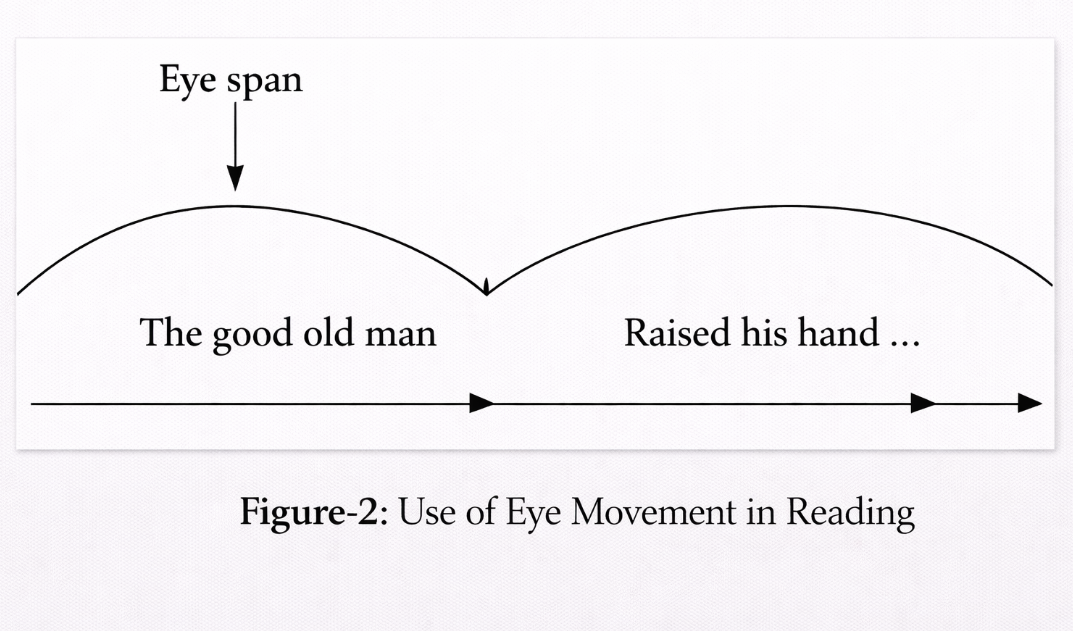
দুর্বল পাঠক শব্দে শব্দে পড়ার কারণে তার Eye span কম এবং Fixation বেশি। দক্ষ পাঠকের Eye span থাকে প্রসারিত এবং Fixation কম হয়। অর্থাৎ Reading-এ যার Eye span যত কম Fixation-এ সে তত বেশি দক্ষ Reader হিসেবে বিবেচিত হবে। পড়ার সময় আমাদের দৃষ্টি শুধু একটি লাইনে সীমাবদ্ধ থাকে না, উপর নিচেও চলে যায়। সে ক্ষেত্রে দক্ষ পাঠক Passage -এর শুধু Key words বা মূল শব্দগুলো দেখে দ্রুত ভাবার্থ হৃদয়ঙ্গম করতে পারে।

কৌশল-২ Reading Sense Group: কৌশলী পাঠক শব্দে শব্দে পড়ে না বরং কতগুলো শব্দ নিয়ে অর্থের যে একটি Unit বা Sense group তৈরি হয় তা পড়ে থাকে। এই কৌশলকে আমরা Phrase readingও বলতে পারি। বাক্যের শব্দগুলোকে Phrase by phrase ভাগ করে পড়লে পঠন দ্রুত হয় এবং অর্থ দ্রুত বুঝতেও সুবিধা হয়। যেমন একজন ভালো পাঠক নিচের বাক্যটি পড়বে এভাবে-

The good old man | raised his hands | in blessing.

দক্ষ পাঠক এই বাক্যটিকে মাত্র দুই fixation-এ পড়ে ফেলতে পারে। পক্ষান্তরে একজন দুর্বল পাঠক বাক্যটি পড়বে এভাবে -

The good | old man | raised his | hand in | blessing.

এভাবে একাধিক Sense group-এর মধ্যে যদি দ্রুত সমন্বয় সাধন করা যায় তাহলে Passage-এর Message বুঝা সহজতর হয়।

একটি Passage কে বিভিন্ন Sense group বা Phrase-এ একটি কলামে লিখে অনুশীলন করা যেতে পারে, এভাবে-

In this way

it is hoped

he will accustom himself

to taking in
increasingly long chunks of text

at a single eye fixation.

কৌশল-৩ Visual Reading: Reading দুই প্রকার: 1. Silent reading 2. Reading aloud. অনেকে পড়ার সময় মুখে শব্দ উচ্চারণ করে পড়েন, শব্দ না করে পড়লে তাদের পড়া হয় না- এরা আসলে ভালো পাঠক নন। দক্ষ পাঠক মনে মনে পড়েন, মনের কান দিয়ে শোনেন, মানসপটে আঁকেন অর্থচিত্র, অনুভব করেন হৃদয় দিয়ে। শব্দ করে পড়ার বদ অভ্যাস ত্যাগ করতে না পারলে কখনোই ভালো পাঠক হওয়া যাবে না।

কৌশল-৪ Reading Formats and Layouts: 'একটি Passage কোন স্টাইলে মুদ্রণ করা হয়েছে' পড়ার সময় তা অনেকেই খেয়াল না করলেও Comprehension-এর জন্য এটি একটি সহজ অথচ খুবই গুরুত্বপূর্ণ কৌশল। মুদ্রিত লেখার আকৃতি (Font size), স্টাইল (eg Times/Arial), Bold, Italic, Capitalization এমনকি Punctuation, layout ইত্যাদি সতর্কতার সাথে খেয়াল রাখা Reading-এর জন্য খুবই গুরুত্বপূর্ণ। যেমন- Passage-এর Layout দেখলে বুঝায় এর কোন অংশ কোনটির সাথে যুক্ত। বাম মার্জিন থেকে একটু ডানে সরে (Indentation) লেখা শুরু হলে নতুন Paragraph নির্দেশ করে। গুরুত্ব বুঝানোর জন্য অথবা কারো কথা উদ্ধৃত করার জন্য Single অথবা Double quotation marks ব্যবহার করা হয়। তেমনি Passage-টি যদি Dialogue আকারে থাকে তাহলে তা না পড়েই শুধু Layout দেখে বুঝা যায়। তবে সবচেয়ে গুরুত্বপূর্ণ হচ্ছে- বড় হাতের অক্ষর (Capitalization), মোটা অক্ষর (Bold) ও বাঁকা অক্ষর (Italic)-এর ব্যবহার বিভিন্ন কারণে বা উদ্দেশ্যে passage-এ দেয়া থাকতে পারে। যেমন-

  • কঠিন শব্দ, যা সম্বন্ধে পরে প্রশ্ন করা হবে তা Bold করে দেয়া থাকতে পারে--
    The total annual precipitation of an area with fourty inches of rain ....
  • বাক্যের মধ্যে কোনো শব্দ Capital letter দিয়ে শুরু হলে বুঝতে হবে এটি Proper noun,
  • কোনো বই বা ফিল্মের নাম Italic করে দেয়া থাকতে পারে-
    The jewish character is successfully depicted in The Merchannt of Venice.
  • বিদেশী শব্দ বা শব্দগুচ্ছ Italic করা থাকে।
    A species of viola is viola calaminaria.
  • কোনো বিশেষ Word বা Phrase বিশেষভাবে উল্লেখ করতে-
    We can't understand what they called total satisfaction.

কৌশল-৫ Pre-reading Activities: মূল Reading শুরু করার আগে এমন কিছু কাজ আছে যা করলে comprehension-এর কাজ অনেক দূর এগিয়ে যেতে পারে। Pre-reading-এর মধ্যে থাকতে পারে--

  • Title বা শিরোনাম পাঠ।
  • প্রথম প্যারাগ্রাফের প্রথম দুটি বাক্য পাঠ।
  • প্রতিটি প্যারাগ্রাফের ১ম ও শেষ বাক্য পাঠ।
  • Topic sentence বা মূল বাক্যটি সনাক্তকরণ।

সাধারণত Passage-এর শিরোনাম (যদি থাকে) দেখেই এর বিষয়বস্তু অনুমান করা যায়। শিরোনাম না থাকলে অনেক সময় প্যারাগ্রাফের ১ম বা শেষ বাক্যে আসল কথাটি বলা থাকে। আর যদি Topic sentence-টি কোনো রকমে সনাক্ত করা যায় তাহলে তো কথাই নেই-পড়ার আগেই Reading শেষ।

Skimming: Reading-এর প্রধান কৌশল হচ্ছে Skimming । Skimming অর্থ -

Glancing rapidly through a text to determine its gist.

অর্থাৎ মূল বিষয়বস্তু জানার জন্য কোনো Passage-এর ওপর দ্রুতবেগে চোখ বুলানোকে Skimming বলা হয়। এ ক্ষেত্রে Top-down process of reading প্রয়োগ করা হয়। কোনো Passage-এর Title বা শিরোনাম নির্ধারণ অথবা লেখকের ব্যঞ্জনার্থ (implication) নির্বাচন সংক্রান্ত প্রশ্নের উত্তর দিতে skimming অত্যাবশ্যক কৌশল।

কৌশল-৭ Scanning: Comprehension-এর অধিকাংশ প্রশ্নোত্তর এই কৌশল ছাড়া অসম্ভব। scanning অর্থ-

Glancing rapidly through a text either to search for a specific piece of information (eg. name, date etc) or to get an initial impression of difficulty level.

অর্থাৎ Passage-এ বর্ণিত কোনো সুনির্দিষ্ট তথ্য (যেমন- নাম, সন বা তারিখ) বের করার জন্য অথবা Passage-টি কতটা কঠিন তা নির্ণয়ের জন্য Passage-এর ওপর দিয়ে দ্রুত চোখ বুলানোকে Scanning বলে। যেসব বিষয় খুঁজতে Scanning ব্যবহৃত হয় তা হচ্ছে-

  • ব্যক্তি, বস্তু, স্থানের নাম বের করতে
  • কোনো সন বা তারিখ খুঁজতে
  • কতটি বিষয় বা কতজন ব্যক্তি সম্বন্ধে আলোচনা করা হয়েছে
  • ব্যক্তি বা বস্তুর মধ্যে সম্পর্ক বের করতে
  • Pronoun-এর Reference বের করতে।

কৌশল-৮ Marking the Text: দক্ষ Reading-এর অন্যতম একটি কৌশল হচ্ছে পড়ার সময় গুরুত্বপূর্ণ ব্যক্তি, বস্তু, স্থান, সন, তারিখ ইত্যাদি দাগ দেয়া। বিষয়ের আধিক্য থাকলে বিভিন্ন ধরনের দাগ ব্যবহার করা যেতে পারে। Scanning-এর সময় এসব বিষয় দাগাদাগি করলে প্রশ্নোত্তর দ্রুততার সাথে শেষ করা সম্ভব।

কৌশল-৯ Using Context Clue কোনো একটি বিষয় কোন পরিপ্রেক্ষিতে বর্ণনা করা হয়েছে তাকে বলা হয় এর context। আর যেসব শব্দ, শব্দগুচ্ছ বা বাক্য এর অনুধাবনে সাহায্য করে তাদের বলা হয় Context clues। সাধারণত মোটামুটি কঠিন প্রশ্নের উত্তর দিতে Context clue-এর ব্যবহার খুবই গুরুত্বপূর্ণ। বিশেষ করে Passage-এ অনুক্ত বিষয় সম্বন্ধে অনুমান করা Context clue ছাড়া সম্ভব নয়।
কৌশল-১০ Using Background Knowledge: Reading-এ Background knowledge-এর গুরুত্ব সম্পর্কে আগেই বিস্তারিত আলোচনা করা হয়েছে। কোনো বিষয় পড়ার সময় সে সম্পর্কে পাঠক যদি তার পূর্বজ্ঞান ও অভিজ্ঞতার আশ্রয় নেয় তাহলে Passage বুঝতে সুবিধা হয়। যেমন- কোনো Passage-এ যদি উপজাতীয় সংস্কৃতি সম্বন্ধে আলোচিত হয় আর এ ব্যাপারে যদি পাঠকের পূর্বজ্ঞান বা অভিজ্ঞতা থাকে তাহলে সে সহজেই তা বুঝতে পারবে। পক্ষান্তরে এ ব্যাপারে অনভিজ্ঞ পাঠকের Text বুঝতে সমস্যা হবে।

কৌশল-১১ Guessing/Predicting: জটিল কোনো শব্দ আসলে দক্ষ পাঠক একেবারে দমে যায় না বা থেমে থাকে না। অজানা শব্দের অর্থ বা লেখকের ব্যঞ্জনার্থ বুঝতে Guessing খুবই কার্যকর। যেমন- একটি বাক্যে যদি মোট ১৫টি শব্দ থাকে এবং তন্মধ্যে ৪টি শব্দ কঠিন/ অজানা থাকে, তাহলে পাঠক বাকি ১১টি শব্দার্থ ব্যবহার করে কঠিন এই ৪টি শব্দের অর্থ অনুমান করতে পারে।

কৌশল-১২ Using Affixation: ইংরেজিতে এমন কতগুলো উপসর্গ বা বিভক্তি আছে যা দ্বারা অজানা শব্দের অর্থ জানা সম্ভব। এগুলোকে বলা হয় Affix। Affix দুই প্রকার। ১. Prefix- যা শব্দের পূর্বে বসে। যেমন- pre, re, un ইত্যাদি। ২. Suffix- যা শব্দের পরে বসে। যেমন- -able, -tion, -sion ইত্যাদি।

উদাহরণত: Prediction শব্দটিতে আছে pre যার অর্থ পূর্বে, diction অর্থ বলা। সুতরাং prediction অর্থ পূর্বে বলা বা অনুমান করা।

কৌশল-১৩ Using Etymology: Etymology অর্থ শব্দের উৎপত্তি তত্ত্ববিদ্যা। ইংরেজি অনেক শব্দ গ্রিক ও ল্যাটিন ভাষার সমন্বয়ে গঠিত। তাই Etymology ব্যবহার করে কঠিন শব্দের অর্থ উদঘাটন করা অনেক সহজ হয়ে যায়। যেমন-cide এমন একটি গ্রিক শব্দ যার অর্থ 'হত্যা করা' এ থেকে অন্যান্য যে শব্দ পাওয়া যায় তা হলো-

Suicide আত্মহত্যা (sui= নিজ)

Genocide গণহত্যা (geno = গণ)

Matricide মাতৃহত্যা (matr = মা)

Fratricide ভাতৃ হত্যা (fratr = ভাই) ইত্যাদি ইত্যাদি।

কৌশল-১৪ Using Connector: ইংরেজিতে এমন কিছু সংযোজক (Conjunction) আছে যা দ্বারা কোনো অজানা শব্দের অর্থ বা লেখকের Attitude জানা যায়। Passage-এর পূর্ণাঙ্গ অর্থ হৃদয়ঙ্গম করতে এসবের যথেষ্ট ভূমিকা রয়েছে। যেমন- Your argument is weak but his argument is cogent। এখানে but, Connector-টি দ্বারা সহজেই Cogent শব্দটির অর্থ বুঝা যায়।

Differences between Efficient and Inefficient Reader
(দক্ষ ও অদক্ষ পাঠকের মধ্যে পার্থক্যসমূহ)
General Differences (সাধারণ পার্থক্যসমূহ)
Efficient Reader (দক্ষ পাঠক)Inefficient Reader (অদক্ষ পাঠক)
Efficient readers read ideas (দক্ষ পাঠক পড়ে ভাব ও ভাবার্থ)Inefficient readers read words (অদক্ষ পাঠক পড়ে শব্দ)
দক্ষ পাঠক শব্দগুচ্ছ বা Phrase ভাগ করে করে পড়ে।অদক্ষ পাঠক পড়ে Word by word অর্থাৎ শব্দগুলো আলাদা আলাদা করে পড়ে।

Efficient readers visualize ideas

(দক্ষ পাঠক passage -এর idea গুলোকে মানসপটে অঙ্কিত করে)

Inefficient readers vocalize words

(অদক্ষ পাঠক সশব্দে শব্দগুলোকে পড়ে যায়)

দক্ষ পাঠক পড়ার একটি উদ্দেশ্য নির্ধারণ করে।অদক্ষ পাঠক 'Passage-এর শেষ পর্যন্ত' পড়তে থাকে।
দক্ষ পাঠক প্রয়োজন অনুযায়ী পড়ার Speed নির্ধারণ করেঅদক্ষ পাঠক প্রতিটি বিষয় আস্তে আস্তে ও অত্যধিক সতর্কতার সাথে পড়ে।
দক্ষ পাঠক অব্যাহতভাবে পড়তে থাকেঅদক্ষ পাঠক বুঝার জন্য একই বাক্য বারবার পড়ে।
সংশ্লিষ্ট বিষয়ে দক্ষ পাঠকের রয়েছে সমৃদ্ধ Vocabulary বা শব্দ ভাণ্ডার দক্ষ পাঠক তার দৃষ্টিকে স্বচ্ছন্দ গতিতে চালায় ও নিয়ন্ত্রণ করে।

সংশ্লিষ্ট বিষয়ে অদক্ষ পাঠকের থাকে সীমিত Vocabulary.

অদক্ষ পাঠকের দৃষ্টি বিভিন্ন দিকে বিচরণ করে।

দক্ষ পাঠক প্রত্যহ দ্রুত গতিতে Reading-এর অনুশীলন করে।অদক্ষ পাঠক Speeded reading practice করে না বললেই চলে।
মনে রাখার জন্য বা দ্রুত তথ্য বের করার জন্য দক্ষ পাঠক Passage-এর বিভিন্ন স্থানে দাগ দেয়।অদক্ষ পাঠক পৃষ্ঠাকে রাখে ঝকঝকে তকতকে।
দক্ষ পাঠক সমালোচনামূলক, রম্য, সাহিত্যিক ইত্যাদি বিভিন্ন ভাগে Reading-কে বিভক্ত করে।অদক্ষ পাঠক বাছবিচার না করে সবকিছু পড়ে।
Specific Differences (সুনির্দিষ্ট পার্থক্যসমূহ)
Area(ক্ষেত্র)Efficient Reader (দক্ষ পাঠক)Inefficient Reader (অদক্ষ পাঠক)
  1. Language (ভাষা)
Text-এর ভাষা পাঠকের কাছে বোধগম্য বলে মনে হয়।Passage-এর ভাষা পাঠকের কাছে খুবই কঠিন মনে হয়।
  1. Contents (বিষয়বস্তু)
Passage-এর বিষয়বস্তু পাঠকের কাছে সহজ মনে হয়। এ সম্পর্কে সে যথেষ্ট জ্ঞান রাখে। তাই সে তার পূর্বজ্ঞান প্রয়োগ করতে পারে।Passage-এর বিষয়বস্তু পাঠকের কাছে খুবই কঠিন মনে হয় এই কারণে যে বিষয়বস্তু সম্পর্কে তার পূর্বজ্ঞান ও অভিজ্ঞতা নেই।
  1. Speed (দ্রুততা
পাঠক মোটামুটি দ্রুততার সাথে পড়ে যায় কারণ বাক্যের গঠন সে স্বাভাবিকভাবেই চিনতে পারে। ফলে প্রতিটি শব্দ ও শব্দগুচ্ছ আলাদা আলাদা করে পড়ে সময় নষ্ট করে না।পড়ার গতি মন্থর। Vocabulary সমৃদ্ধ না হওয়ায় স্বাভাবিক পঠন পদে পদে বাধাগ্রস্ত হয়।
  1. Attention মনোযোগ
পাঠক শুধু Key word বা গুরুত্বপূর্ণ শব্দগুলোর দিকে মনোযোগ দেয়, বাকিগুলো এড়িয়ে যায়, এমনকি Text-এর গুরুত্বহীন মনে হলে কিছু অংশ বাদও দিয়ে যায়।অদক্ষ পাঠক Passage-এর সব অংশগুলোতেই সমান মনোযোগ দেয়। ফলে সময় নষ্ট হয়। প্রশ্নোত্তরে পূর্ণ মনোযোগের সময় পায় না।
  1. Incomprehensible

Vocabulary (অজানা শব্দ)

দক্ষ পাঠক অজানা শব্দ সহজভাবে গ্রহণ করে এবং আশেপাশের জানা শব্দগুলো দিয়ে এগুলোর অর্থ অনুমান করে অথবা সেগুলো এড়িয়ে গিয়ে যে কোনোভাবে তা সামলে নেয়। এতে ফল না হলে বিশেষ ক্ষেত্রে অভিধান ব্যবহার করে।অদক্ষ পাঠক অজানা শব্দ সহ্যই করতে পারে না। সে শব্দে শব্দে থামে ও বার বার অভিধান দেখে। ফলে বিরক্তি জন্মে এবং Text-এর সামগ্রিক অর্থ অনুধাবন প্রচেষ্টায় নিরুৎসাহিত হয়।
  1. Prediction (অনুমান)
দক্ষ পাঠক অনুমানে এগিয়ে থাকে। Passage-এ অনুক্ত বিষয়ে অনুমানের মাধ্যমে একটি ধারণা জন্মানোর চেষ্টা করে।অদক্ষ পাঠক অনুমান করতে পারে না। ফলে Text-এ যা বর্ণিত থাকে তা নিয়েই ব্যস্ত থাকে।
  1. Background Information

(পূর্বজ্ঞান বা পূর্বে জানা তথ্যের ব্যবহার)

দক্ষ পাঠকের পূর্বে অর্জিত জ্ঞান, তথ্য ও অভিজ্ঞতা Text-এর অর্থ অনুধাবনে সহায়তা করে।দক্ষ পাঠকের পূর্বে অর্জিত জ্ঞান, তথ্য ও অভিজ্ঞতা Text-এর অর্থ অনুধাবনে সহায়তা করে।
  1. Purpose (উদ্দেশ্য)
যে কোনো বিষয় পড়ার ক্ষেত্রে দক্ষ পাঠকের একটি সুনির্দিষ্ট উদ্দেশ্য থাকে। যেমন- জ্ঞানার্জন, তথ্য সংগ্রহ বা আনন্দ লাভ।অদক্ষ পাঠকের সুস্পষ্ট বা সুনির্দিষ্ট কোনো লক্ষ্য থাকে না। বাধ্য হয়ে বা শিক্ষকের আদেশ পালনের জন্য পড়ে।
  1. Motivation (প্রেষণা)
পাঠক কোনো বিষয়ে নিজে আগ্রহান্বিত হয়ে বা এটাকে একটি চ্যালেঞ্জিং কাজ মনে করে পড়তে উদ্বুদ্ধ হয়।Reading-এ অদক্ষ পাঠকের বিশেষ কোনো আগ্রহ বা উৎসাহ থাকে না।
  1. Strategies (কৌশল ব্যবহার)
প্রয়োজন অনুযায়ী বিভিন্ন ধরনের Text-এর জন্য বিভিন্ন কৌশল অবলম্বন করে।অদক্ষ পাঠক একই কৌশল সব ধরনের Text-এ ব্যবহার করে থাকে।

Related Question

View All
উত্তরঃ

Sustainable Energy: A Global Imperative

Global energy demand, crucial for industrialization, is a major problem as conventional sources (coal, gas, oil, nuclear) are polluting, scarce, costly, or risky. This necessitates developing new, sustainable alternatives like solar, geothermal, and ocean energy. Successfully harnessing these clean, abundant, and cheap resources ensures uninterrupted supply, environmental safety, energy independence, and rapid economic development, especially for poorer nations.

Satt AI
Satt AI
1 week ago
1.5k
শিক্ষকদের জন্য বিশেষভাবে তৈরি

১ ক্লিকে প্রশ্ন, শীট, সাজেশন
অনলাইন পরীক্ষা তৈরির সফটওয়্যার!

শুধু প্রশ্ন সিলেক্ট করুন — প্রশ্নপত্র অটোমেটিক তৈরি!

প্রশ্ন এডিট করা যাবে
জলছাপ দেয়া যাবে
ঠিকানা যুক্ত করা যাবে
Logo, Motto যুক্ত হবে
অটো প্রতিষ্ঠানের নাম
অটো সময়, পূর্ণমান
প্রশ্ন এডিট করা যাবে
জলছাপ দেয়া যাবে
ঠিকানা যুক্ত করা যাবে
Logo, Motto যুক্ত হবে
অটো প্রতিষ্ঠানের নাম
অটো সময়, পূর্ণমান
অটো নির্দেশনা (এডিটযোগ্য)
অটো বিষয় ও অধ্যায়
OMR সংযুক্ত করা যাবে
ফন্ট, কলাম, ডিভাইডার
প্রশ্ন/অপশন স্টাইল পরিবর্তন
সেট কোড, বিষয় কোড
অটো নির্দেশনা (এডিটযোগ্য)
অটো বিষয় ও অধ্যায়
OMR সংযুক্ত করা যাবে
ফন্ট, কলাম, ডিভাইডার
প্রশ্ন/অপশন স্টাইল পরিবর্তন
সেট কোড, বিষয় কোড
এখনই শুরু করুন ডেমো দেখুন
৫০,০০০+
শিক্ষক
৩০ লক্ষ+
প্রশ্নপত্র

Related Question

মাত্র ১৫ পয়সায় প্রশ্নপত্র
১ ক্লিকে প্রশ্ন, শীট, সাজেশন তৈরি করুন আজই

Complete Exam
Preparation

Learn, practice, analyse and improve

1M+ downloads
4.6 · 8k+ Reviews